Learning Ally Review: The Human-Read Audiobook Library That Levels the Playing Field for Every Student
Learning Ally gives blind, visually impaired, and dyslexic students access to over 80,000 human-narrated audiobooks and textbooks. Discover how this nonprofit platform empowers learners across the US, UK, Pakistan, and Asia — and why sighted students are finding value in it too.
Inclusive Info Hub
The Student Who Falls Behind Is Not the Problem. The System Is.
Picture a classroom in any school — in Houston, in London, in Lahore, in Manila. A teacher assigns thirty pages from a history textbook before tomorrow's class. Every student goes home with the same assignment. But not every student goes home with the same ability to complete it.
A student who is blind cannot read the print textbook. A student with dyslexia reads it, but by the time they reach page ten, they have spent so much mental energy decoding words that they have retained almost nothing. A student with a visual impairment strains through large-print editions if they are lucky enough to have one. A student with a physical disability cannot hold the book. A student with ADHD starts, loses focus, restarts, and finishes two pages in an hour.
Meanwhile, the assignment does not change. The deadline does not change. And the grade, in the end, reflects the same standard for all of them.
This is the problem that Learning Ally has spent over seventy years trying to solve — not by lowering the bar, but by changing how students reach it.
What Is Learning Ally?
Learning Ally is a nonprofit organization and audiobook platform that provides human-narrated textbooks, literature, and educational content to students with print disabilities — including blindness, visual impairment, dyslexia, and physical disabilities that prevent reading standard print.
Originally known as Recording for the Blind and Dyslexic, the organization rebranded as Learning Ally in 2011. The name change reflected something important: the mission had grown beyond its original focus. Learning Ally today serves anyone for whom standard print creates a barrier — a definition far broader than blindness alone.
The platform has been used by two million students and 450,000 educators, spanning 21,000 elementary schools, middle schools, and high schools. Those are not small numbers. They represent decades of advocacy, fundraising, volunteer recording work, and institutional trust built by a nonprofit that has stayed focused on a single mission since 1948.
The core product is the Learning Ally Audiobook app — available on iOS, Android, Mac, PC, and Chrome — which gives members access to a library of over 80,000 human-narrated titles. But the app is only one part of what Learning Ally offers. The platform also includes teacher tools, educator training programs, progress tracking dashboards, and family support resources that together make it something closer to a complete accessibility ecosystem than a simple reading app.
Why Human Narration Matters More Than You Think
Most text-to-speech tools use synthesized computer voices — even the best AI voices available today. Learning Ally takes a fundamentally different approach: the library offers over 80,000 human-narrated audiobooks and audio textbooks for dyslexic, blind, and visually impaired readers.
This distinction is not just a marketing point. It has real consequences for how students learn.
A human narrator brings natural pacing, proper emphasis, and emotional nuance to text in a way that no AI voice yet replicates consistently. When a history textbook describes a battle, a human narrator's pacing reflects the weight of that content. When a novel shifts tone, a human narrator shifts with it. Punctuation is respected naturally. Technical terms in science and medicine are pronounced correctly by narrators who have prepared for them.
For a student who is already working harder than their peers just to access the same content, the cognitive relief of a genuinely listenable narration is not a luxury. It is the difference between getting through the chapter and giving up halfway.
Learning Ally is a lot more than just an app, since most literacy apps simply provide the tool and let the teacher figure out the training and implementation. The organization has invested in the quality of both the recordings and the surrounding support structure in ways that free, generic alternatives have not.
Who Learning Ally Is Built For
Blind and Totally Visually Impaired Students
For students who are completely blind, Learning Ally solves one of the most persistent gaps in accessible education: the textbook. Digital content has become increasingly accessible through screen readers and TTS apps, but the textbook remains a problem. Many textbooks — particularly in sciences, history, and literature — are not digitized in accessible formats. Publishers move slowly. School budgets do not always stretch to specialized formats.
Learning Ally's library includes textbooks across subjects from kindergarten through post-graduate and professional levels. The digital audiobook library contains over 80,000 titles, including textbooks on specialty and academic subjects from kindergarten through post-graduate and professional level. A blind student at any level of education can search the library for their required textbook and, in most cases, find a human-narrated version waiting.
The app is compatible with VoiceOver on iOS, which is the most critical accessibility requirement for blind iPhone users. However, it is worth being honest about a limitation that real users have raised: some blind users have reported that the app's custom controls and interface structure are better optimized for low-vision users than for completely non-visual navigation. The recommendation for blind users is to use the list view rather than the default book cover view, as the list view is optimized for screen readers. Exporting content and navigating through the app's table of contents features work reliably with VoiceOver when the correct display mode is selected.
Students With Dyslexia
Learning Ally was initially created for blind and dyslexic students and has evolved to include support for learners below grade level, those with special needs, and other disabilities. It can serve students on 504 and IEP plans as well as RTI and MTSS students without a diagnosis but who require additional support.
Dyslexia is perhaps where Learning Ally has its deepest impact. The numbers are staggering: approximately one in five people has dyslexia, making it by far the most common learning difference in education. The vast majority of these students sit in mainstream classrooms with no accommodation at all — not because the accommodations do not exist, but because the system has not reached them yet.
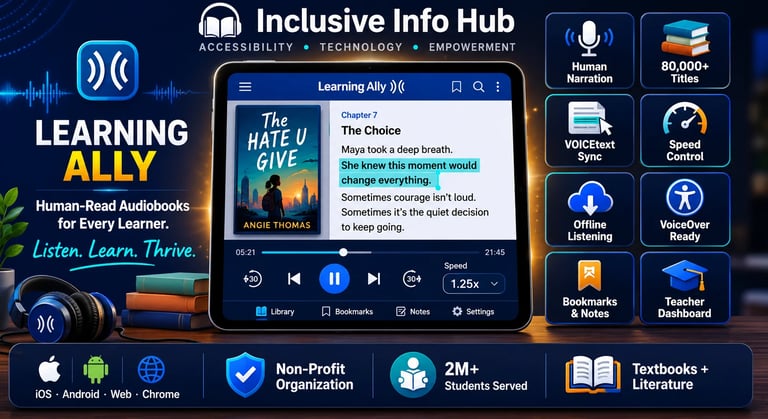
Learning Ally's VOICEtext format directly addresses the core challenge of dyslexia. VOICEtext includes on-screen highlighted text synced with the audio narration. This means a student with dyslexia does not simply listen passively — they read along, their eyes following the highlighted word as it is spoken. The brain receives the same information simultaneously through two channels — auditory and visual — which research has consistently shown improves comprehension, vocabulary retention, and reading fluency over time.
This is not a workaround for dyslexia. It is a research-backed instructional approach. The goal is not just to help the student complete today's assignment. It is to gradually build the reading skills that the standard classroom environment failed to develop.
Students With Low Vision
Students with low vision — who have partial sight but cannot read standard print comfortably — benefit from Learning Ally's combination of audio narration and adjustable visual display. The app includes adjustable speed, text size, and text and highlighting color settings. A low-vision student can enlarge text to a readable size, select a high-contrast color scheme, and listen with synchronized audio — combining visual and auditory input in whatever proportion works for their specific level of sight.
Students With Physical Disabilities
For students whose physical disabilities prevent them from holding a book, turning pages, or typing for extended periods, Learning Ally eliminates the physical demands of reading entirely. The app plays through a locked screen, works with headphones, and navigates through chapter and page controls that can be operated with minimal physical interaction. The app makes it easy to follow along by highlighting words as they are read to enhance comprehension, vocabulary, and fluency — all without requiring the student to physically engage with a printed object.
Students With ADHD
Sustained reading requires sustained attention — which is precisely what ADHD makes difficult. The synchronized audio-text experience of Learning Ally reduces the attention demand of reading by removing the need to consciously decode every word. The student's attention can stay with meaning and comprehension rather than with the mechanical process of reading. The ability to adjust playback speed also helps: some students with ADHD focus better at slightly faster speeds, which reduces the mental space for distraction.
How Learning Ally Helps Sighted Students Too
This is the section that deserves more attention than it typically gets. Learning Ally requires membership eligibility based on a print disability, so it is not an open-access tool for any sighted student who wants to use it. But within that eligibility framework, the benefits extend to a broader group than most people realize — and for sighted students outside the platform, the lessons of what Learning Ally does well apply to how any student should think about audio-based learning.
Students Who Are Sighted But Struggle With Reading Fluency
Not every struggling reader has a formal diagnosis. Many students read slowly, lose comprehension when reading long passages, or find dense academic texts genuinely difficult to process visually — without ever qualifying for a formal learning disability label. Learning Ally supports students with dyslexia and other learning disabilities to improve their reading skills by listening. These books are intended to help improve comprehension and understanding of the texts instead of focusing on the mechanics of reading, allowing students to develop higher-level critical thinking skills and enjoy what they are reading.
This framing matters. The goal is not to replace reading. It is to shift attention from the mechanics of decoding to the substance of understanding — which is where learning actually happens.
Bilingual and English Language Learner Students
For students who speak English as a second language, reading academic texts is doubly difficult: they are processing content and language simultaneously. Listening to human-narrated audio while reading along trains both comprehension and pronunciation in an academic context. A student whose first language is Urdu, Tagalog, or Mandarin studying in English-medium schools can use Learning Ally to hear correct spoken English in academic registers — textbooks, literature, professional writing — while reading along at their own pace.
Audio Learning as a Revision Strategy
Students who qualify for Learning Ally membership can use the platform's audiobooks as a revision tool before exams. Listening to a chapter of a history textbook or a piece of literature during a commute, while exercising, or with eyes closed in a relaxed state engages the content through a different channel than visual re-reading. This is not a niche approach — it is a well-documented strategy in educational psychology for improving long-term retention.
Parents Reading With Their Children
Learning Ally membership can be used as a family tool. A parent helping a child with dyslexia through homework can use the synchronized audio-text feature together, turning what is often a frustrating nightly battle into a shared, structured listening and reading experience. The online library includes a huge selection of human-narrated textbooks and literature for readers of all ages that can be downloaded and listened to on most computers, smartphones, and tablets.
Key Features Explained
VOICEtext — The Synchronized Reading Experience
VOICEtext is Learning Ally's flagship format and the feature that most directly distinguishes it from a standard audiobook platform. It is not simply an audio recording played alongside static text. The system synchronizes the audio narration with the on-screen text word by word, highlighting each word as it is spoken in real time. The effect is a multisensory reading experience that engages the eyes and ears simultaneously.
For dyslexic students particularly, this synchronized experience is where the real educational value lives. The brain is being trained to connect the visual appearance of words with their correct pronunciation and meaning — which is exactly the remediation that dyslexia requires.
Human-Narrated Library of 80,000+ Titles
The library spans fiction and nonfiction, bestsellers and classics, and crucially — textbooks. Through the Learning Ally Audiobook app, students have access to the textbooks and curriculum they need to read as well as the popular fiction and series titles they want to read. The inclusion of both required academic content and recreational reading is deliberate. Students with print disabilities deserve access to the books they choose to read, not just the ones assigned to them.
Titles include widely read series and bestsellers — Harry Potter, Percy Jackson, Diary of a Wimpy Kid, The Fault in Our Stars — alongside curriculum-aligned textbooks in science, history, mathematics, and language arts at every grade level.
Speed Control and Playback Customization
Students can control how the audiobook is read aloud by modifying the reading speed. Speed adjustment is available across a meaningful range, allowing students to slow down for complex technical content and speed up during familiar or review material. Combined with adjustable text size and highlighting color, the app gives students genuine control over their reading environment — something print textbooks simply cannot offer.
Bookmarks, Highlights, and Notes
Students have interactive learning tools including highlighted text synced with the audio narration, speed control, bookmarking, highlighting, and note-taking. These study tools transform the app from a passive listening experience into an active study environment. A student can bookmark a key passage, highlight a definition, and add a written note — then export their annotations as part of their study materials. The same tools that sighted students use with physical highlighters and sticky notes are available here in a fully accessible digital format.
Offline Listening
Books can be listened to online or offline even while the device is locked. Downloaded titles play without an internet connection, which is a critical feature for students in areas with unreliable connectivity. The app works during commutes, in low-signal areas, and during travel without any degradation in experience.
Page and Chapter Navigation Matching Print Editions
One of the most practical features for students using Learning Ally alongside print-based classrooms is that the table of contents and page numbers match those of the same print edition. When a teacher says "turn to page 47," a Learning Ally user can navigate directly to that page in the audio version. This synchronization with the standard print edition means the student participates in the same lesson as their classmates, following the same content in real time rather than working through a separately structured adaptation.
Teacher Dashboard and Progress Tracking
While connected to WiFi, students' reading progress syncs to the educator portal, with data updating nightly. Teachers can log into their portal and see which books each student is reading, how far they have progressed, and how much time they have spent listening. For schools using Learning Ally as an official accommodation, this tracking capability means teachers can monitor engagement without requiring students to self-report — removing one more barrier for students who may feel embarrassed about needing accommodation.
Learning Ally provides an array of professional learning programs and training for teachers including Dyslexia Awareness Training, Structured Literacy in Action, Learning Ally Audiobook Solution Workshop, Excite Reading Workshop, and the Supporting Striving Readers at Home session. This educator support infrastructure is unusual for an assistive technology platform and reflects Learning Ally's identity as a nonprofit invested in systemic change rather than just product sales.
Learning Ally for Students in Pakistan and Across Asia
The honest picture for students in Pakistan, India, Bangladesh, and across South and Southeast Asia requires a direct and transparent conversation about what Learning Ally can and cannot offer in these regions.
The Copyright Limitation
This is the most important point to address clearly. Due to U.S. Copyright law, Learning Ally does not offer distribution of Learning Ally's downloadable audiobooks outside of the United States. The platform operates under a special provision of US copyright law — the Chafee Amendment and the Marrakesh Treaty implementation — that permits distribution of accessible format materials to people with print disabilities. This legal framework currently limits full membership access primarily to US-based students and schools.
This means that students in Pakistan, India, and most of Asia cannot access the full Learning Ally audiobook library as individual members in the same way US students can. This is a genuine limitation and it would be dishonest to write around it.
What This Means in Practice for Asian Students
However, the story does not end there — and there are several reasons why students and educators across Asia should still know about Learning Ally.
First, the Learning Ally model — human-narrated accessible audiobooks with synchronized text highlighting, teacher dashboards, and professional development for educators — represents the international standard for what quality accessible education technology looks like. Educators in Pakistan, India, and across Asia who are building inclusive education programs can look to Learning Ally as a benchmark for what their own institutions and governments should be working toward.
Second, for students from Pakistan, India, or other Asian countries who are studying in the United States — including the very large South Asian student communities at American universities — Learning Ally membership is fully accessible and available. Pakistani students at US institutions are eligible for membership if they have a qualifying print disability, and this is a resource that many international students in the US overlook entirely.
Third, similar platforms exist in other countries — RNIB Bookshare in the UK, the CNIB Library in Canada, Vision Australia's library services, and the Marrakesh Treaty network of libraries — that operate on the same principles as Learning Ally and serve students in their respective regions. Students in Asia who know about Learning Ally know what to look for in their own national context.
Fourth, the teacher training programs and professional development resources offered by Learning Ally are globally accessible and represent valuable knowledge for educators building inclusive classrooms in Pakistan, India, and across Asia regardless of whether their students can access the audiobook library directly.
The Broader Lesson for South Asian Education
The situation with Learning Ally actually highlights a wider gap: accessible textbooks, human-narrated academic content, and properly resourced inclusive education remain deeply underfunded across South and Southeast Asia. The infrastructure that makes Learning Ally possible in the US — the Chafee Amendment, vocational rehabilitation funding, the IDA, the NFB — does not have equivalent counterparts at scale in Pakistan or India yet.
Advocating for that infrastructure — for government-funded accessible textbook programs, for teacher training in dyslexia and visual impairment, for copyright exemptions that allow accessible format production — is work that students, educators, and parents in these countries can push for directly. Learning Ally is proof that it can be built.
Learning Ally in Tier 1 Markets: US, UK, Canada, and Australia
United States
In the US, Learning Ally's reach is genuinely impressive. The platform has been used by two million students and 450,000 educators, spanning 21,000 elementary schools, middle schools, and high schools. School memberships are purchased at the institutional level, meaning students at member schools access the platform at no personal cost. Individual memberships are available directly for families.
Individuals do not need an IEP or 504 in order to qualify. There is no expiration date on qualification once provided by a professional. This is an important and often misunderstood point. A student does not need to go through a lengthy formal special education process to qualify for Learning Ally. A teacher, educational psychologist, or reading specialist who identifies a qualifying reading deficit can certify eligibility — and that certification does not expire.
For families where the cost of membership is a barrier, hardship waivers and financial assistance programs are available. Hardship waivers are granted to individuals who qualify for them. The organization's nonprofit status means that serving students who cannot afford membership is part of the mission, not an afterthought.
United Kingdom
In the UK, RNIB Bookshare — operated in partnership with Bookshare — provides a similar service to UK students with print disabilities and is the closest equivalent to Learning Ally available. UK students and educators researching Learning Ally should investigate RNIB Bookshare as the most directly comparable domestic resource, while the Learning Ally model remains relevant as a reference point for what quality accessible education technology delivers.
Canada and Australia
Canadian students with print disabilities can access similar services through NNELS (National Network for Equitable Library Service) and CNIB's digital library. Australian students can access Vision Australia's library services and through the Marrakesh Treaty implementation.
For professionals in all these markets — lawyers, medical practitioners, executives, academics with print disabilities — Learning Ally's library extends beyond school-age content into post-graduate and professional titles, making it relevant well beyond K-12 education.
Pricing: What Does Membership Cost?
The Learning Ally annual membership costs $135 per year. This covers unlimited access to the full audiobook catalog, access to the Learning Ally app on all supported platforms, and access to special events, conferences, and scholarship programs.
For applicants who cannot afford the cost of membership, you can apply to have the fee waived through their assistance program. This financial hardship provision is real and actively used — Learning Ally's nonprofit status means the organization has a genuine interest in removing financial barriers to access.
School and institutional memberships are structured differently and typically provide access for an entire student population at a per-student or flat-rate institutional fee. Schools using Learning Ally as an official accommodation tool should contact the organization directly for institutional pricing, which varies by school size and type.
For US students whose disability qualifies them for vocational rehabilitation services, VR funding can often cover the cost of Learning Ally membership as an assistive technology accommodation. It is worth asking your VR counselor or disability services office specifically about this before paying out of pocket.
Limitations Worth Knowing
The VoiceOver experience on the mobile app has been a point of friction for some completely blind users. A review on AppleVis noted that the app's custom controls do not always interact smoothly with screen reader navigation, creating an experience that feels optimized for sighted users with reading disabilities rather than for users with no functional vision. Learning Ally has been working on improvements in this area, and the list view mode is the recommended setting for blind users, but it is an honest limitation to flag.
The geographic restriction to US-based audiobook distribution is a significant barrier for the global audience that could benefit from this platform. The Marrakesh Treaty — an international copyright agreement that facilitates accessible format sharing across borders — is gradually expanding the framework for cross-border distribution, but implementation at scale remains a work in progress.
The app is available in English only. For multilingual students or those studying in non-English-medium institutions, this limits the platform's direct utility.
The membership requirement — while justified by copyright law and the costs of producing high-quality human narrations — means there is no free tier to try before committing. The app can be downloaded for free, but without a membership login, no content is accessible.
Where to Download and How to Join
iOS: Search "Learning Ally Audiobooks" on the Apple App Store.
Android: Search "Learning Ally Audiobooks" on Google Play.
Mac: Available on the Mac App Store.
Chrome: Available as an extension on the Chrome Web Store — search "Learning Ally Audiobooks."
Web: Visit learningally.org to apply for membership, check eligibility, and access the full library through a browser.
For Schools: Contact Learning Ally directly through learningally.org for institutional membership pricing and implementation support.
For Students Who Cannot Afford Membership: Apply for financial assistance directly through the membership application at learningally.org. Hardship waivers are available and the process is straightforward.
The Verdict: Who Should Use Learning Ally?
Learning Ally earns a strong recommendation for:
Blind and visually impaired students in the US who need human-narrated textbooks and academic content with reliable screen reader support — particularly in the list view mode on the app.
Students with dyslexia at any age for whom the VOICEtext synchronized reading experience represents a research-backed intervention, not just an accommodation.
Students with physical disabilities who need hands-free, locked-screen audio access to academic content.
Schools and educators in the US looking for a proven, nonprofit-backed accessible reading solution with teacher training and progress tracking included.
International students from Asia studying in the US who have a qualifying print disability and have not yet discovered this resource.
Educators and policymakers in Pakistan, India, and across Asia who want to understand what a fully realized accessible education technology platform looks like — and what their own systems should be building toward.
A Final Word
Learning Ally has been doing this work for over seventy years. Long before AI voices, before smartphones, before the App Store — volunteers sat in recording studios and read textbooks aloud so that a blind child somewhere could do their homework. That mission has not changed. The technology around it has simply caught up.
What the platform represents is a belief that every student — regardless of how their brain processes text or how their eyes perceive the page — deserves access to the same knowledge. Not an easier version of it. Not a simplified summary of it. The real thing, delivered in a way they can actually receive.
That belief, backed by seven decades of practice and a library of eighty thousand human voices, is what makes Learning Ally worth knowing about — wherever in the world you are sitting when you read this.