Lingvano Review 2026: Learn ASL and BSL From Deaf Teachers — The Sign Language App 3 Million People Trust
Lingvano is a sign language learning app for ASL, BSL, and Auslan with video lessons taught by Deaf teachers, Sign Mirror feedback, and interactive quizzes. Available on iOS and Android. Full 2026 review for learners in Pakistan, Asia, the US, and UK.
APPS FOR HI SUPPORTLATEST TECHNOLOGYEDUCATION
Inclusive Info Hub
According to the World Health Organization, over 1.5 billion people worldwide live with some degree of hearing loss, and for deaf people who use sign language as their primary mode of communication, one of the most consistent and painful barriers is not a technology gap but a human one. The hearing family member who never learned to sign. The colleague who communicates entirely through written notes. The parent who raised a deaf child without ever becoming conversational in their child's language. At Inclusive Info Hub, every hearing accessibility app reviewed here is measured by one honest standard: does it remove a real daily barrier, and does it do so in a way that genuinely respects the community it serves.
Picture a hearing mother in Lahore whose eight-year-old son has been deaf since birth. He attends a school for the deaf where he has developed fluency in sign language. She communicates with him through basic gestures, facial expressions, and written notes. She loves him completely and understands him partially. She wants to speak his language — not approximate it or gesture at it, but actually learn it properly. She does not live near a sign language class. She works full-time. She has fifteen minutes in the evening after her son goes to sleep.
Lingvano was built for exactly this mother. And for the three million other people who have already started learning through it.
What Is Lingvano?
Lingvano is a mobile sign language learning application that teaches American Sign Language, British Sign Language, and Australian Sign Language through structured video lessons created by Deaf teachers, interactive practice tools, and a gamified learning experience designed for complete beginners with no prior knowledge of sign language required.
The app is available on both the Apple App Store and Google Play Store as "Lingvano: Sign Language ASL" published by Lingvano GmbH. It uses a freemium model with a free trial providing access to introductory content and a paid subscription unlocking the complete course library, dictionary, Vocab Trainer, and Sign Mirror feature.
Three million people have joined Lingvano to start learning sign language. That number reflects something important about who uses this app and why. The majority of Lingvano's users are hearing people learning sign language to communicate with a deaf family member, friend, colleague, or student — not deaf people themselves. Understanding this primary audience and what Lingvano does for them is central to understanding why the app belongs in a hearing accessibility series.
A Critical Clarification — Who Lingvano Is Really For
Most apps in this series are for deaf and hard of hearing users themselves. Lingvano serves a different but equally important accessibility purpose. Its primary users are hearing people learning sign language — and the accessibility impact of that learning is felt directly by the deaf people in those learners' lives.
A deaf child whose hearing parent learns to sign through Lingvano gains a parent who can communicate with them fluently. A deaf employee whose hearing manager learns basic workplace signs through Lingvano gains a workplace that is marginally more inclusive. A deaf student whose hearing classmates have used Lingvano gains study partners who can participate in sign language conversation rather than defaulting to written notes.
This is accessibility at one remove — the tool does not directly serve the deaf person, but its effect on the hearing people around them is a direct accessibility benefit for the deaf community. Lingvano understands this and names it explicitly. One App Store reviewer made the point directly: you are paying for Deaf individuals' work compensation which is a big deal — referencing the fact that Lingvano's lessons are taught by Deaf teachers who are being paid for professional instruction work, and that every subscription contributes to that economic inclusion.
The Lessons Are Taught by Deaf Teachers — Why This Matters
This is the single most important quality differentiator in the sign language learning app market and deserves more than a bullet point.
Sign language is not a visual representation of spoken English. ASL has its own grammar, syntax, and structure that differs fundamentally from English. BSL similarly has its own distinct grammar. Learning to sign from a hearing person who learned sign language as a second language — however fluent they may be — is a qualitatively different experience from learning from a native Deaf signer for whom the language is their primary mode of thought and communication.
Lingvano's video lessons are created and taught by Deaf teachers who are native or fluent signers. Every lesson reflects the authentic grammar, rhythm, and expressiveness of sign language as it is actually used in Deaf communities rather than as a simplified visual approximation of spoken language. For a learner who wants to communicate genuinely with a deaf family member or colleague rather than approximate it, this distinction matters enormously.
One App Store reviewer who was already attending local ASL classes with a Deaf community noted that Lingvano teaches ASL grammar correctly — the structure is different from English grammar, and using this app helps to demonstrate that and break it down in an interactive way. This is not a review of a beginner's gesture guide. It is a confirmation that the linguistic content is authentic.
Who Lingvano Is Built For
Hearing Family Members of Deaf People
This is Lingvano's most impactful primary audience and the one the app serves best. A hearing parent, sibling, spouse, or child of a deaf family member who wants to learn their loved one's language has historically faced limited options — expensive formal classes, community courses with limited schedules, or YouTube tutorials with no structure or progression. Lingvano provides structured, progressive, teacher-led instruction at fifteen minutes a day on a phone that is already in the family member's pocket.
Educators Working With Deaf and Hard of Hearing Students
A hearing teacher who has a deaf or hard of hearing student in their classroom and wants to learn enough sign language to communicate directly — rather than always routing through an interpreter — gains a practical professional tool in Lingvano. The structured lesson format covers classroom-relevant vocabulary and conversational skills that apply directly to educational interactions.
Hearing Colleagues of Deaf Professionals
Workplaces are more inclusive when deaf employees are not the only people responsible for bridging the communication gap. A hearing colleague who learns even basic workplace sign language through Lingvano — greetings, common phrases, relevant work vocabulary — contributes to an environment where a deaf colleague's participation is normalized rather than managed.
Deaf and Hard of Hearing Users Learning a New Sign Language
While Lingvano's primary audience is hearing learners, deaf users from countries where ASL or BSL are not the native sign language can use Lingvano to learn these internationally recognized sign languages. A deaf user in Pakistan, India, or another country where a local sign language is used but where ASL is widely referenced in educational and professional contexts may find Lingvano's structured curriculum a more effective learning environment than self-directed video resources.
Complete Beginners With No Sign Language Background
Lingvano is the perfect starting point for beginners, with video lessons made by Deaf teachers that can be done anywhere, anytime. A complete beginner will start signing in their very first lesson and can become conversational with just 10 minutes per day of practice. The app makes no assumption of prior knowledge and scaffolds learning from fingerspelling and basic vocabulary through grammar and conversational dialogue.
Key Features in Full Detail
Structured Video Lessons From Deaf Teachers
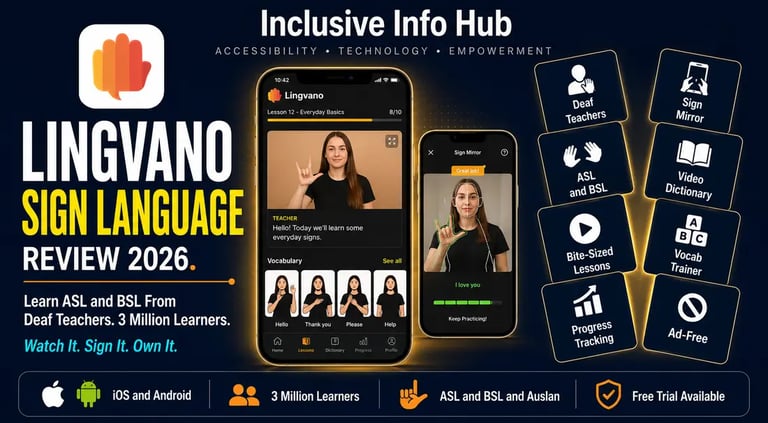
Every Lingvano lesson is delivered through video taught by Deaf instructors. Lessons are bite-sized, typically five to fifteen minutes, covering specific vocabulary sets, grammar concepts, and conversational contexts. The progressive structure moves from foundational fingerspelling and numbers through common phrases, grammar rules, and full conversational dialogue across beginner, intermediate, and advanced levels.
Video lessons can be played at reduced speed, allowing learners to study individual sign movements in detail before attempting to replicate them. This adjustable playback speed is particularly useful for complex signs involving multiple simultaneous hand, arm, and facial components.
Sign Mirror
Sign Mirror is the feature that most directly elevates Lingvano above a passive video learning experience. Using the phone's front-facing camera, Sign Mirror displays a real-time view of the learner's own signing alongside a ghost outline guide showing the correct sign form and position. The learner can see immediately whether their hand position, movement, and orientation match the correct sign — receiving visual feedback that a text description of a sign cannot provide.
This real-time visual self-correction is the closest a mobile app can come to the feedback loop of in-person instruction with a Deaf teacher. One reviewer specifically named the Sign Mirror as a game-changer for correcting form and building confidence faster. Sign Mirror is available to premium subscribers.
Vocab Trainer
A dedicated vocabulary training tool tests learners on previously covered signs through spaced repetition, presenting signs for identification and asking learners to select the correct meaning from multiple options or to recall and produce the sign from a written prompt. The spaced repetition approach is the most evidence-based method for long-term vocabulary retention in any language.
Video Dictionary
A searchable dictionary of signs with video demonstrations of each sign's correct form, allowing learners to look up specific vocabulary outside of structured lessons. The dictionary is particularly useful for learners who encounter a sign in conversation or media that they have not covered in their lesson sequence yet.
Interactive Quizzes
Each lesson concludes with interactive quiz exercises that test comprehension and production of the signs covered. Quiz formats include video identification, multiple-choice vocabulary questions, and fingerspelling challenges. Progress on quizzes is tracked and contributes to the app's overall progress visualization.
Progress Tracking
Premium users have access to detailed progress tracking showing lessons completed, vocabulary retained, time studied per day, and overall course progression. For learners working toward a specific communication goal — being able to have a basic conversation with a deaf family member by a target date — progress tracking provides the motivation structure that self-directed learning often lacks.
Completely Ad-Free
Lingvano contains no advertising. This is not a minor point for an app used primarily in short fifteen-minute learning sessions where interruptions disrupt concentration and undermine retention. An ad-free learning environment reflects the app's positioning as a paid educational tool rather than a free tool monetized through advertising.
Course Coverage — ASL, BSL, and Auslan
Lingvano currently offers structured courses in American Sign Language, British Sign Language, and Australian Sign Language. The ASL course is the most developed and comprehensive, covering vocabulary to complex conversations with the full range of features including Sign Mirror, Vocab Trainer, and dialogue practice. BSL coverage is solid for beginners. Auslan coverage is more introductory in depth than ASL. Austrian Sign Language is referenced in some external sources but is not prominently featured in the current main course catalog.
Lingvano vs Duolingo for Sign Language — The Honest Comparison
Many potential users ask whether Lingvano is simply a sign language version of Duolingo. The comparison is fair in terms of gamification and bite-sized daily lessons but misses the most important distinction.
Duolingo does not currently offer sign language courses. Lingvano occupies a specific market position as the only major structured, app-based sign language learning platform with video lessons from Deaf teachers across ASL, BSL, and Auslan.
The gamification comparison to Duolingo is accurate in structure — daily streaks, progress bars, lesson completion badges, and quiz formats. The pedagogical content is fundamentally different because sign language is a visual-spatial language and requires video instruction from native signers in a way that Duolingo's text-and-audio format cannot replicate even conceptually.
Pricing — Free Trial and Subscription Options
Lingvano uses a freemium model. The app is free to download with introductory content available without payment, allowing a learner to complete several lessons before needing to subscribe to continue.
Premium subscription pricing as of 2026 is approximately $17.99 per month, $47.99 for three months, or $119.99 per year. The annual subscription represents the best per-month value at approximately $10 per month and is the most cost-effective option for learners committed to a sustained learning program.
Premium unlocks the complete course library, the Sign Mirror feature, the Vocab Trainer, the Video Dictionary, and progress tracking. The free tier provides access to introductory lessons and a limited vocabulary experience that allows genuine evaluation before subscribing.
For learners in Pakistan and South Asia, the subscription pricing in USD represents a meaningful financial commitment relative to local income levels. The annual plan at approximately $10 per month is the most financially manageable option for sustained learning. For family members who want only basic conversational competency rather than full fluency, the introductory free content covers a meaningful first layer of communication skills before any payment is required.
Honest Limitations
Sign language coverage is weighted toward ASL. The ASL course is the most developed. BSL coverage is solid for beginners but less deep than ASL at advanced levels. Auslan is more introductory. Users specifically targeting BSL or Auslan should manage expectations about the depth of content available compared to the ASL track.
No Urdu, Pakistani, or South Asian sign language support. Pakistan Sign Language is used by the deaf community in Pakistan but is not covered by Lingvano. The app teaches ASL, BSL, and Auslan — all Western sign languages. For a Pakistani deaf user whose family is learning to communicate with them specifically in PSL, Lingvano does not provide this content. This is a meaningful gap for the South Asian audience this blog serves.
Sign Mirror requires premium subscription. The feature most directly useful for practicing correct sign production is locked to premium. Free tier learners cannot assess whether they are signing correctly, which limits the practical value of free tier learning for genuine skill development.
Music interruption bug reported by users. Multiple users have reported that the Lingvano app pauses any music or podcast playing in the background when the app is reopened, disrupting the listening habits of learners who prefer to have background audio during screen time. This has been reported to the developer but was not resolved as of recent user reviews.
Subscription cost may not be justified for very casual learners. For a hearing family member who wants only basic communication with a deaf relative — greetings, simple requests, common household vocabulary — the free introductory content may cover all immediately needed content without requiring a premium subscription. The premium is best justified for learners with sustained commitment to reaching conversational fluency.
App Store Details — Verified and Confirmed
Apple App Store: Search "Lingvano: Sign Language ASL" published by Lingvano GmbH. Free to download with premium subscription required for full access. Available globally.
Google Play Store: Search "Lingvano: Sign Language ASL" published by Lingvano GmbH. Free to download with premium subscription. Available globally including Pakistan, India, and South Asia.
Frequently Asked Questions
Is Lingvano free? The app is free to download with introductory lesson content available at no cost. Full course access including the complete ASL and BSL curriculum, Sign Mirror, Vocab Trainer, and Video Dictionary requires a premium subscription at approximately $17.99 per month, $47.99 for three months, or $119.99 per year.
Is Lingvano available in Pakistan? Yes. The app is available globally on both the Apple App Store and Google Play Store with no regional restrictions. The free introductory content is accessible without payment in Pakistan.
Does Lingvano teach Pakistan Sign Language? No. Lingvano currently teaches American Sign Language, British Sign Language, and Australian Sign Language. Pakistan Sign Language is not available on the platform. Learners specifically targeting PSL will need to explore other resources.
Is Lingvano good for complete beginners with no sign language background? Yes. Lingvano is specifically designed for complete beginners with no prior knowledge of sign language. The first lesson begins with foundational content and the progression is gradual, covering fingerspelling, basic vocabulary, grammar, and conversational dialogue across beginner, intermediate, and advanced levels.
Who teaches the lessons on Lingvano? All lessons are taught by Deaf teachers who are native or fluent signers. This is Lingvano's most important quality differentiator — the instruction reflects authentic sign language as used in Deaf communities rather than a simplified approximation taught by hearing instructors.
Can deaf users benefit from Lingvano? Yes, particularly deaf users from countries where ASL or BSL are not the native sign language who want to learn these internationally recognized sign languages for educational, professional, or social reasons. The primary audience is hearing learners, but deaf users learning a new sign language can benefit from the structured curriculum and video instruction.
What This Means for Families and Communities in Pakistan and Across Asia
Whether you are a hearing parent in Lahore who wants to communicate properly with a deaf child, a teacher in Karachi with a hard of hearing student in your classroom, or a colleague in Dhaka who works with a deaf professional and wants to bridge the communication gap with more than written notes — Lingvano provides the most structured, teacher-led, video-based ASL and BSL learning experience currently available on a mobile platform, at a price point far below formal sign language classes.
The Pakistan Sign Language gap is real and worth naming honestly. For families where the deaf family member uses PSL specifically, Lingvano does not directly teach that language. However, ASL is widely referenced in educational and professional accessibility contexts in Pakistan and across South Asia, and BSL is directly relevant for Pakistani families with connections to the United Kingdom. For these learners Lingvano's curriculum is directly applicable.
The deeper point is this: every hearing person who learns any sign language through Lingvano contributes, in a small but real way, to a world where deaf people are less dependent on writing, gesturing, and hoping that the hearing person in front of them makes the effort to understand. Learning sign language is an act of inclusion. Lingvano makes that act accessible, affordable, and achievable fifteen minutes at a time.
A Closing Thought
There is something that the hearing mother in Lahore will discover when she has been using Lingvano for three months and sits down with her deaf son. Not that she is fluent. She is not yet. But that she can sign "good morning" and he will sign back and his face will change in a way it did not change when she wrote the words on paper. Because she is not writing his language at him. She is speaking it.
That moment — which is not about an app but is made possible by one — is what sign language learning is actually for. Not linguistic accomplishment. Human connection across a barrier that has been treated as permanent for too long.
Lingvano does not build that connection. It builds the skill that makes the connection possible. At fifteen minutes a day, starting today, for free.
Read More on Inclusive Info Hub
👉 10 Best Apps for Deaf and Hard of Hearing Users — where Live Transcribe sits in the full picture: Read our complete guide here → [10 BEST APPS DEAF HH ARTICLE LINK]
👉 Ava — live group conversation captions with 99% accuracy and human scribes: Read our full review here → [AVA Article link]
👉 Best AI Accessibility Tools in 2026 — complete guide including OCR and document tools: Read our full guide here → [BEST AI ACCESSIBILITY TOOLS ARTICLE LINK]
👉Nagish now Rylo — the free global captioned calling alternative: Read our full review here — [RYLO NAGISH ARTICLE LINK]
👉Google Live Transcribe — free Android real-time captions for face-to-face conversations: Read our full review here — [GOOGLE LIVE TRANSCRIBE ARTICLE LINK]