RogerVoice Review 2026: 10 Million Captioned Calls and Counting — The Phone Call App Built by Someone Who Could Not Use One
RogerVoice is a free FCC-certified captioned phone call app for deaf and hard of hearing users supporting 100 languages across 50 countries. Available on iOS and Android. Full 2026 review for users in Pakistan, Asia, the US, and UK.
APPS FOR HI SUPPORTLATEST TECHNOLOGYEDUCATION
Inclusive Info Hub
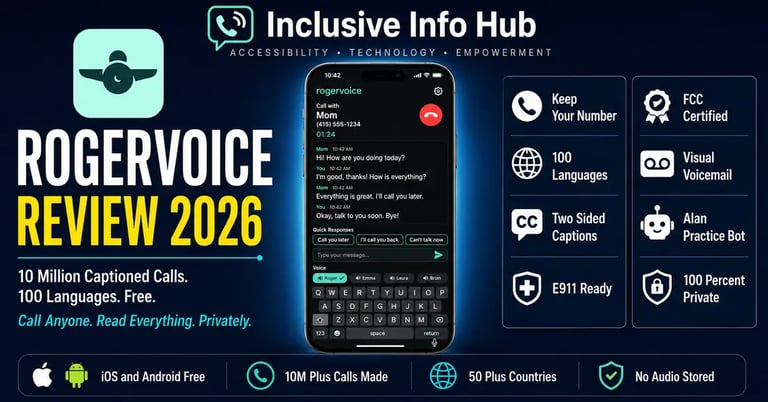
According to the World Health Organization, over 1.5 billion people worldwide live with some degree of hearing loss, and the phone call remains one of the most persistent daily barriers they face. At Inclusive Info Hub, every hearing accessibility app reviewed here is measured by one honest question: does it give deaf and hard of hearing users the same independence on the phone that hearing users have never had to think about. RogerVoice answered that question by surpassing 10 million captioned calls across 100 languages in over 50 countries in April 2026 — a milestone that belongs not to a large corporation's accessibility initiative but to a French startup founded by a man who has been deaf since the age of two.
Picture a 68-year-old woman in London, unable to understand phone conversations even with her hearing aids. Phone calls have become a disaster for her — her words, not a reviewer's characterization. She downloads RogerVoice and makes her first captioned call. For the first time in years, she reads every word the other person says in real time, on her screen, as they speak. She does not need to ask for repetition. She does not need to ask her daughter to make the call for her. She makes it herself.
That is 10 million calls worth of stories like hers. This is where they start.
The Story Behind RogerVoice
Most accessibility apps are built by teams of engineers who research a problem and design a solution. RogerVoice was built by someone who lived the problem every day.
Olivier Jeannel has been profoundly deaf since the age of two. Growing up, he experienced firsthand how isolating phone calls could be when audio was the only option. In 2014, he founded RogerVoice with one specific mission: to make phone conversations accessible to deaf and hard of hearing people without requiring an interpreter, a relay operator, or anyone else to be present on a private call.
The name itself is a nod to aviation communication — "Roger" being the standard radio acknowledgment meaning "message received and understood." For a deaf person making a phone call, hearing that message received is exactly what the app delivers.
In April 2026, RogerVoice officially launched US operations and became FCC certified, crossing 10 million captioned calls in the process. The certification means eligible US users with hearing loss can now use RogerVoice completely free through the federally funded Telephone Relay Service program. Nearly 55 percent of RogerVoice users make at least one to two calls per day, with 24 percent making more than five calls daily — demonstrating that for the people who use it, captioned calling has become an essential everyday tool rather than an occasional accommodation.
Platform Clarification — Both Stores Confirmed
You may have heard that RogerVoice is iOS only. This is incorrect. Here are the verified details for both platforms:
Apple App Store: Search "Rogervoice: Call Captions" published by RogerVoice. Free to download. Available globally.
Google Play Store: Search "Rogervoice Phone Call Captions" published by RogerVoice. Free to download. Available globally.
Website: rogervoice.com for account management and additional information.
The app is available on both iOS and Android with the same core features across both platforms. Now writing the full review with both platforms confirmed.
What RogerVoice Actually Does
The core function is precisely defined and deliberately limited to doing one thing exceptionally well: captioning phone calls in real time.
When a user makes or receives a call through RogerVoice, the words spoken by the hearing caller appear as captions on the deaf user's screen word-for-word as they are spoken — not after a sentence is completed, not after a processing delay, but as each word leaves the other person's mouth. The caption display is clean, large, and scrollable, with the most recent words always visible at the bottom of the screen where the eye naturally rests during a call.
The privacy architecture deserves specific attention because it is central to what makes this app genuinely different from traditional relay services. RogerVoice uses AI-powered voice recognition with no third party involved in any call. No relay operator hears the conversation. No audio is stored on RogerVoice's servers. All call transcripts are localized on the user's device only. Every connection between the app and its servers is encrypted. A deaf user making a call to their doctor, their bank, their employer, or anyone else has exactly the same privacy as a hearing user making the same call through their native phone app.
Key Features in Full Detail
Keep Your Existing Phone Number
Setting up RogerVoice requires nothing more than entering your existing phone number into the app. From that point, when people call that number the app automatically picks up with captions active. When you want to call someone, you dial from within the app using your contacts or by entering a number manually. The entire transition is invisible to hearing callers — they see your same number, hear a normal ringing tone, and speak to you exactly as they would on any other call. Nothing changes for them. Everything changes for you.
Word-for-Word Real Time Captions
The captioning engine processes speech as it is spoken, displaying each word on screen within a second of being said. The accuracy reflects AI that has been refined since 2014 across millions of calls in over 100 languages — a training dataset that few competitors can match in depth or linguistic range. One user described the experience directly: when their contact speaks, everything they say is transcribed instantly, word-for-word in real time.
Two-Sided Captions
RogerVoice offers an app-to-app calling feature where hearing friends and family members can download the app and receive a real time copy of the captions as they speak — allowing them to verify that their words are being accurately received and to correct any misunderstanding immediately. This two-sided visibility transforms a captioned call from a one-directional accessibility accommodation into a shared, collaborative communication experience.
Type to Speak
Rather than speaking their side of the conversation, a deaf or speech-disabled user can type their response and RogerVoice reads it aloud to the hearing caller using a synthetic voice. Multiple voice profiles in both genders are available, allowing a user to select a voice that feels appropriate to them. Users who can speak clearly may use their own voice while reading the other person's captions. Users who prefer not to speak for any reason can type instead. The app handles both situations without requiring any special configuration switch between them.
Quick Responses
Pre-set phrases appear as tappable buttons above the keyboard during a call, allowing common responses to be sent instantly without typing them out each time. These phrases are fully customizable — a user can set up responses specific to their work, their personal life, or the types of calls they make most frequently. One tap sends "Please hold on," "Can you repeat that more slowly," or any other phrase the user has pre-configured.
Interactive Dial-Tone Navigation
Many customer service hotlines and automated phone systems use touch-tone menus — "press 1 for billing, press 2 for technical support." RogerVoice supports interactive dial-tone navigation, allowing a deaf user to tap through these menus within the app without needing to switch to their native phone dialer mid-call.
Alan the Practice Bot
This feature is one of the most thoughtful onboarding touches in any accessibility app reviewed on this blog. For a deaf user who has never made a captioned phone call before and feels uncertain about how the experience will work, RogerVoice includes a special contact named Alan — a friendly robot available for practice calls at any time. A user can call Alan before making their first real captioned call, get comfortable with reading captions in real time, and build confidence in the interaction model before their first live call with a real person.
The psychological significance of this is easy to underestimate. For a person who has avoided phone calls for years or decades, the prospect of making a first captioned call carries real anxiety. Alan removes the stakes from that first attempt entirely.
Visual Voicemail Transcription
Voicemail messages are automatically transcribed and presented as readable text, with a call search history that allows a user to find specific past conversations by keyword, phone number, or contact name. Transcripts can now be exported to save or share information from calls that contained important details. For a deaf user who has historically had no reliable way to access voicemail without sighted assistance, this visual voicemail capability represents a complete resolution of a long-standing practical barrier.
Fully Customizable Display
The caption display is adjustable across high-contrast modes, dark and light themes, color-sensitive themes for users with colour vision differences, and extra-large font sizes for users with low vision in addition to hearing loss. The customization extends to full-screen mode for video calls and enhanced interface options introduced in recent updates.
E911 Emergency Call Captions
RogerVoice provides live captions for emergency calls with optional automated location services that allow emergency responders to pinpoint the caller's location, saving response time in critical situations. This E911 compatibility is currently available in the United States only. Users outside the United States should use their mobile carrier's native dialer for emergency calls.
100 Languages Across 50 Countries
The language support is one of RogerVoice's strongest differentiating features relative to other captioned calling apps. While competitors like Rylo focus primarily on English with limited additional language support, RogerVoice transcribes over 100 languages and connects users across more than 50 countries. Spanish, Italian, Vietnamese, Turkish, French, and dozens of additional languages are supported for both captioning and international calls. For deaf users in Pakistan, South Asia, and internationally who make calls in languages other than English, this multilingual depth is a meaningful practical advantage.
Pricing — Complete and Honest
For US Users with Hearing Loss: RogerVoice is completely free for eligible US citizens who are deaf or hard of hearing, funded through the federal Telephone Relay Service program. FCC certification is required and users must have a US Social Security Number and address to register for federally funded access.
For International Users Including Pakistan and South Asia: RogerVoice offers paid plans for users outside the United States. A 2-hour credit valid for one year is available for occasional callers. Monthly subscription plans are available starting at approximately €1.99 per month for up to one hour of captioned calls. The first hour of calls is free for new users regardless of location, providing a meaningful evaluation period before any payment is required.
This international pricing model is the clearest distinction in the comparison between RogerVoice and Rylo for users in Pakistan and South Asia. Rylo is free globally as a business decision. RogerVoice is free for US users as a regulatory outcome and paid for international users beyond the free trial hour. For heavy daily callers in Pakistan and South Asia, this cost difference is worth factoring into the decision between the two apps.
Who RogerVoice Is Built For
Deaf Adults Who Make Frequent Phone Calls
Nearly 55 percent of RogerVoice users make at least one to two calls per day. This is not a tool for occasional use. It is a daily communication infrastructure for deaf professionals, parents, students, and individuals who previously avoided phone calls or depended on hearing people to make them. The call history, searchable transcripts, and exportable records reflect a product designed for users who make many calls and need to reference them afterward.
Hard of Hearing Professionals in Multilingual Work Environments
The 100-language support positions RogerVoice specifically well for hard of hearing professionals who work across international contexts. A hard of hearing professional in a multinational organization who receives calls in English, French, and Spanish can caption all three through the same app without switching tools or accounts. This multilingual breadth is unmatched among captioned calling apps at this price point.
Deaf Users Who Prefer Typing to Speaking
The type-to-speak feature with multiple voice profiles serves users who either cannot speak clearly due to the nature of their deafness from birth or who prefer not to use their voice on calls for personal reasons. The quality of the synthetic voice has been noted by users as genuinely natural-sounding — one user specifically mentioned that callers enjoyed having a more natural conversation directly without knowing an app was involved.
New Users Anxious About Their First Captioned Call
The Alan practice bot makes RogerVoice specifically welcoming for users who are new to captioned calling and need to build confidence before making live calls. No other captioned calling app in this guide includes an equivalent onboarding feature.
RogerVoice vs Rylo — The Practical Comparison
Both RogerVoice and Rylo are captioned phone call apps covered in this series, and comparing them honestly is the most useful thing this review can do for a reader deciding between them.
Rylo is free globally with no usage limits, English-focused with limited additional language support, strong on features like spam blocking and service directory, and carries over the trust built by Nagish's original community.
RogerVoice is free for US users only with paid plans for international users, supports 100 languages across 50 countries, includes the Alan practice bot and two-sided captions, has a proven track record since 2014, and carries FCC certification as a formally regulated accessibility service.
For users in the United States with documented hearing loss: both are free. RogerVoice's longer track record, FCC certification, and multilingual depth may give it an edge for users who make international calls or calls in languages other than English.
For users in Pakistan and South Asia who make primarily local calls: Rylo's genuinely free global model is the more financially accessible option. RogerVoice's paid international tier for heavy daily callers represents a real ongoing cost. For occasional callers, RogerVoice's free first hour per account provides a meaningful evaluation period.
For users who make calls across multiple languages: RogerVoice's 100-language support is unmatched.
Honest Limitations
International users pay after the first free hour. The federally funded free model applies only to qualifying US users. For deaf and hard of hearing users in Pakistan and internationally, the first hour of captioned calls is free and subsequent usage requires a paid plan. This is a meaningful financial barrier for daily callers in lower-income markets.
AI captioning accuracy is not perfect. Live captions are not perfect and some transcripts can get lost in the conversation, as noted directly in the App Store user review section. The AI captioning engine has improved significantly since 2014 but no captioning service achieves complete accuracy on all accents, speaking speeds, audio quality levels, and background noise conditions. Users who experience critical calls should consider requesting written confirmation of important information shared verbally.
E911 emergency captioning is US only. For users outside the United States who may encounter an emergency situation, RogerVoice's E911 live captioning is not available. The app itself recommends using the native mobile carrier dialer for emergency calls outside the US.
iOS stability issues reported by some users. A portion of App Store reviews mention stability problems on older iOS versions, including app crashes during calls. The developer actively responds to these reports and bug fix updates are released regularly, but users on older iPhone models should be aware of potential stability variability.
The free international hour resets per account, not per month. The 2-hour credit for international users is valid for one year, meaning it is a one-time evaluation credit rather than a recurring monthly free allowance. Heavy callers outside the US will need a paid subscription from their first month of regular use.
Frequently Asked Questions
Is RogerVoice available on both iOS and Android? Yes. RogerVoice is available on the Apple App Store as "Rogervoice: Call Captions" and on Google Play as "Rogervoice Phone Call Captions," both published by RogerVoice. The app works on both platforms with the same core features.
Is RogerVoice free? For eligible US citizens who are deaf or hard of hearing, RogerVoice is completely free through the FCC-certified Telephone Relay Service program. For international users including Pakistan and South Asia, the first hour of captioned calls is free and subsequent use requires a paid subscription plan.
Does RogerVoice store my call audio or transcripts? No. RogerVoice never stores audio or transcriptions on its servers. All call transcripts are saved locally on the user's device only. No third party is involved in any call.
Does RogerVoice support languages other than English? Yes. RogerVoice supports captioning and transcription in over 100 languages across more than 50 countries, including Spanish, Italian, Vietnamese, Turkish, French, and many others. This makes it one of the most linguistically capable captioned calling apps available.
Can I keep my existing phone number with RogerVoice? Yes. Simply enter your existing phone number into the app during setup and RogerVoice handles all incoming and outgoing calls through that number. Hearing callers see and dial your same number without needing the app themselves.
What is Alan in RogerVoice? Alan is a practice robot contact built into RogerVoice that new users can call at any time to practice making captioned calls before their first real conversation. It is designed to help users who feel anxious about their first captioned call build confidence in the format.
What This Means for Users in Pakistan and Across Asia
Whether you are a deaf professional in Lahore who needs to make client calls in English and Urdu, a hard of hearing student in Karachi navigating university administrative calls, or a deaf user in Dhaka communicating with international contacts — RogerVoice's 100-language depth and global availability give it genuine multilingual relevance that most competing apps cannot match.
The paid international model is the honest limitation that matters most for this audience. For a daily caller in Pakistan who needs captioned calls for work, the monthly subscription cost is a real financial consideration. For an occasional caller who needs captioned calls for specific high-importance conversations — a medical appointment, a job interview, a government interaction — the free first hour provides genuine access without any payment required.
The free first hour is worth using for exactly these high-stakes situations. A deaf job applicant in Karachi who needs to handle a phone interview can use RogerVoice's free trial hour for that single call — the most important call they might make in a given month — without committing to a subscription. One user described precisely this experience: RogerVoice helped them land a job because most of their interviews were by phone, and before the app it was a barrier they could not overcome independently.
That single call, in that specific situation, represents the entire case for what this technology is for.
A Closing Thought
Olivier Jeannel built RogerVoice in 2014 because he was deaf and could not use the phone. Not because he saw a market opportunity. Not because a disability services brief landed on his desk. Because he personally needed a tool that did not exist and decided to build it.
By April 2026, the tool he built had handled 10 million captioned calls across 100 languages in over 50 countries. The 68-year-old woman in London who can finally make her own calls. The job applicant who landed the interview. The father who called his children without needing to ask anyone to be present on the line.
Ten million calls. Each one a conversation that happened independently when it might otherwise not have happened at all.
That is what it looks like when someone builds what they needed for themselves and then gives it to the world.
Read More on Inclusive Info Hub
👉 10 Best Apps for Deaf and Hard of Hearing Users — where Live Transcribe sits in the full picture: Read our complete guide here → [10 BEST APPS DEAF HH ARTICLE LINK]
👉 Ava — live group conversation captions with 99% accuracy and human scribes: Read our full review here → [AVA Article link]
👉 Best AI Accessibility Tools in 2026 — complete guide including OCR and document tools: Read our full guide here → [BEST AI ACCESSIBILITY TOOLS ARTICLE LINK]
👉Nagish now Rylo — the free global captioned calling alternative: Read our full review here — [RYLO NAGISH ARTICLE LINK]
👉Google Live Transcribe — free Android real-time captions for face-to-face conversations: Read our full review here — [GOOGLE LIVE TRANSCRIBE ARTICLE LINK]