
OrCam Review 2026: The Wearable AI Device That Reads, Recognizes, and Restores Independence
OrCam MyEye is a finger-sized wearable AI device that reads text, recognizes faces, and identifies money and products for blind and visually impaired users. This 2026 review covers real pricing, features, and honest limitations for buyers in Pakistan and Asia.
DAILY LIVING APPSNAVIGATION APPSLATEST TECHNOLOGY
Inclusive Info Hub

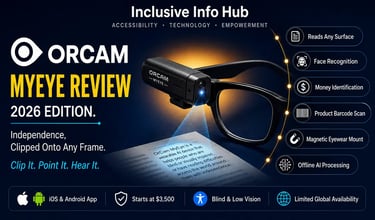
According to a 2016 JAMA Ophthalmology clinical study involving twelve legally blind participants, a portable artificial vision device significantly improved patients' ability to perform daily living tasks such as reading a newspaper, a menu, or a message on a screen — and that device was OrCam. At Inclusive Info Hub, every wearable device reviewed here is judged by one honest standard: does it deliver independence that genuinely justifies its cost, or does it simply repackage something a free app already does.
Picture a man in his seventies, recently diagnosed with end-stage glaucoma, sitting at his own kitchen table holding a letter from his bank that he can no longer read on his own. For years, that letter would have waited for a family member to come by and read it aloud. With a small device clipped onto the corner of his glasses, he points his finger at the page, and within a second or two, his own voice in his ear hears the letter read back to him — privately, immediately, without asking anyone for help.
This is the exact promise OrCam has been building toward since 2010, and in 2026 it remains one of the most clinically validated, if also most expensive, pieces of assistive technology available to blind and visually impaired users anywhere in the world.
What Is OrCam?
OrCam Technologies is an Israeli assistive technology company founded in 2010 by Professor Amnon Shashua and Ziv Aviram in Jerusalem, and its flagship product, OrCam MyEye, is a small camera that clips magnetically onto eyeglass frames and uses artificial intelligence to read text aloud, recognize faces, and identify barcodes and objects — all delivered as audio feedback directly to the user.
What distinguishes OrCam fundamentally from app-based accessibility tools covered elsewhere on this site is that it is a dedicated, standalone piece of hardware rather than software running on a smartphone. There is no camera to hold up, no phone to unlock, no app to open. The device sits permanently on the user's existing eyewear, watching wherever their head is already pointed, and responds to a simple point of the finger or a spoken command.
The company's reach has been genuinely significant for a hardware-focused accessibility business. By March 2017, OrCam had raised $41 million in capital at a $600 million valuation, and continued raising funds through 2021 at a $1.5 billion valuation — a level of investment that reflects how seriously the broader technology and medical device industry has taken this category of product.
How OrCam MyEye Actually Works
The defining design decision behind OrCam MyEye is its complete independence from gesture-based smartphone interaction. The device is about the size of a finger, battery-powered, and snaps onto any eyeglass frame magnetically, weighing just 22.5 grams — light enough that most users report forgetting it is there within the first few days of regular use.
To read text, a user simply points their finger at the document, sign, screen, or surface they want read aloud, and the device's AI processes the visual field and begins reading immediately through a small built-in speaker positioned near the ear, or through a personal earphone for more private listening. Reading can be activated by voice, gesture, or touch, and reading speed can be adjusted from fast to slow depending on the user's preference and the complexity of the material.
Beyond reading, the device handles face recognition for people the user has previously introduced to it, barcode scanning for product identification, and — critically for daily independence in cash-based economies — currency and banknote identification. All of this processing happens through on-device AI rather than requiring a live internet connection, which is a meaningfully different architecture from cloud-dependent tools like Be My AI or Seeing AI's more advanced scene description features.
That is the kind of design decision that does not show up in a feature list, but matters enormously the moment someone is standing in an unfamiliar shop with patchy signal, trying to identify the denomination of the note in their hand.
Who OrCam MyEye Is Genuinely Built For
Blind and Severely Visually Impaired Adults Managing Daily Independence
For users who have lost vision later in life — through conditions like glaucoma, macular degeneration, or diabetic retinopathy — and who did not grow up using screen readers or Braille, OrCam's finger-pointing interaction model offers an unusually intuitive entry point into assistive technology. There is no new alphabet to learn, no gesture system to memorize. You point, and it reads.
Users With End-Stage Glaucoma and Progressive Vision Loss
A dedicated clinical study conducted in partnership with Wills Eye measured the impact of the OrCam device specifically on patients with end-stage glaucoma, concluding that the device allowed legally blind patients to read independently, with a corresponding improvement in overall quality of life. For a population whose vision loss is often gradual and accompanied by a difficult psychological adjustment period, a tool with this level of clinical validation carries real weight beyond marketing claims.
Students and Professionals Who Need Hands-Free, Continuous Reading
Because the device mounts on the face rather than requiring a held phone, OrCam MyEye is particularly well suited to situations involving extended, continuous reading — working through a printed exam paper, reading a multi-page contract, or following along with a printed textbook chapter — without the arm fatigue or repositioning that holding a phone camera steady for long periods inevitably creates.
Users Who Prioritize Offline Reliability Over Cloud-Based AI Sophistication
For users in areas with inconsistent internet connectivity, OrCam's on-device processing model offers a genuine reliability advantage over cloud-dependent competitors. The trade-off, covered honestly below, is that this approach currently delivers less conversationally sophisticated scene description than newer cloud-based AI tools.
Key Features at a Glance
Reads Text From Any Surface — printed pages, signs, restaurant menus, computer and phone screens, all read aloud through simple finger-pointing or voice command.
Face Recognition — once introduced to a person, the device can recognize and announce them on future encounters, helping bridge one of the more socially significant gaps in blindness — knowing who has just entered the room.
Money and Currency Identification — instantly identifies banknote denominations, a feature with direct daily relevance in cash-heavy economies across South Asia and much of the developing world.
Product and Barcode Recognition — scans product packaging to identify items, useful for grocery shopping, medication management, and general household organization.
Smart Reading Commands — voice commands like "find dessert" while scanning a restaurant menu, or "read the headlines" while scanning a newspaper, allow the device to locate and read specific categories of information rather than reading every word indiscriminately from start to finish.
Adjustable Reading Speed — fast or slow playback depending on user preference and material complexity, controlled through the companion app or device buttons directly.
Magnetic Eyewear Mounting — the device clips on and off any standard eyeglass frame without tools or adhesive, meaning a single device can move between a user's regular glasses and sunglasses as needed.
Companion Mobile App — the official OrCam app, available on iOS and Android, controls volume and reading speed settings, allows changing the reading voice, connects the device to WiFi for updates, and includes a "find my device" feature for locating a misplaced unit. The app is compatible with Android Accessibility and VoiceOver modes, ensuring the setup and control process itself remains accessible to blind users rather than requiring sighted assistance.
OrCam MyEye 2 Pro and MyEye 3 Pro: What's Changed
OrCam's product line has evolved through several generations since the original 2013 launch. The OrCam MyEye 2.0, released in December 2017, refined the form factor down to its now-recognizable finger-sized footprint. The current MyEye 2 Pro and MyEye 3 Pro models extend reading capability further, easily activated by voice, gestures, or touch, with smart AI-powered search commands letting users jump directly to specific information within a document rather than reading linearly from the beginning.
The newest generation continues to emphasize the same core philosophy that has defined the product since its earliest version: real-time audio description of text, faces, and objects, delivered through hardware that seamlessly integrates into daily life rather than requiring a deliberate, separate interaction each time.
Pricing: The Number That Changes Everything
This is the section that requires the most direct honesty in this entire review.
OrCam MyEye pricing has historically sat in the range of $3,500 to $4,500 depending on model and region, positioning it as one of the single most expensive pieces of consumer-facing assistive technology available anywhere in the accessibility market. This is not a one-time app purchase or a modest hardware accessory. It is closer in price to a high-end laptop, a used car in some markets, or — in much of Pakistan and South Asia — a meaningful fraction of an average annual household income.
In some US states, OrCam hardware may be eligible for assistive technology funding through Vocational Rehabilitation programs or Medicaid waivers, subject to individual case evaluation, which can meaningfully offset the cost for qualifying users in those specific jurisdictions. No equivalent large-scale public funding infrastructure currently exists across most of Pakistan, India, or Southeast Asia, which means the overwhelming majority of families in the region would need to cover this cost entirely out of pocket.
It needs to be said plainly: at this price point, OrCam MyEye is not a realistic option for the vast majority of students and families across Pakistan and South Asia, regardless of how genuinely effective the underlying technology is.
Honest Limitations
The price is the single largest barrier, by a wide margin. Nothing else in this review matters as much as this one fact for readers across South Asia. A free smartphone app cannot replicate the hands-free, face-mounted convenience of OrCam — but it also does not cost thousands of dollars.
Cloud-based AI competitors are closing the sophistication gap. Newer tools like Be My AI, powered by GPT-4 vision, now offer more conversationally nuanced, detailed scene description than OrCam's on-device processing typically delivers — at zero cost. OrCam's genuine advantage remains offline reliability and hands-free, finger-pointing simplicity rather than raw AI sophistication.
The device is highly specialized rather than general-purpose. Unlike a smartphone running multiple accessibility apps, OrCam MyEye does one category of task very well — reading, recognizing, identifying — but does not replace a phone for navigation, communication, or the broader range of digital accessibility needs a student or professional has throughout a typical day.
Repair and support infrastructure is limited outside major markets. As a specialized hardware device manufactured by a single Israeli company, service centers, replacement parts, and technical support are far less geographically distributed than software solutions, which can create real friction for users in regions without an established OrCam distributor presence.
The company has faced real business headwinds. OrCam conducted its first round of layoffs at the end of 2022, and a planned 2021 public stock offering did not materialize, which is worth noting honestly as a signal of the broader financial pressures facing premium hardware-first accessibility companies in a market increasingly being challenged by free, software-only AI alternatives.
Frequently Asked Questions
How much does OrCam MyEye cost? OrCam MyEye typically costs between $3,500 and $4,500 depending on the specific model and region, making it one of the most expensive consumer assistive technology devices currently on the market.
Does OrCam MyEye work without an internet connection? Yes. OrCam MyEye processes reading, face recognition, and object identification through on-device AI, meaning it functions fully offline once set up — a meaningful advantage for users in areas with unreliable internet connectivity.
Is OrCam MyEye available in Pakistan? OrCam does not currently have a major official distribution presence across most of Pakistan and South Asia, and the device's price point puts it out of reach for the vast majority of families in the region even where it can be ordered internationally.
What is the difference between OrCam MyEye and OrCam Learn? OrCam MyEye is built for blind and visually impaired users, reading any printed or digital text aloud and recognizing faces, money, and products. OrCam Learn is a separate, education-focused device designed for students with reading differences such as dyslexia, including features like Reading Pal performance feedback and adjustable word spacing. The two serve meaningfully different primary users despite sharing the same parent company and underlying reading technology.
Is OrCam MyEye better than free apps like Seeing AI or Be My AI? Not universally better — they serve different needs at very different price points. OrCam offers hands-free, offline, finger-pointing simplicity that no phone app fully replicates, while Seeing AI and Be My AI offer comparable or more sophisticated AI description entirely free, provided the user is comfortable holding and aiming a smartphone camera.
👉 We have written a full guide comparing free AI accessibility tools, including
Best AI Accessibility Tools in 2026 guide here
What This Means for Students and Professionals in Pakistan and Across Asia
Whether you are a recently vision-impaired professional in Lahore weighing assistive technology options, or a family in Karachi researching support for an aging parent with glaucoma, the honest reality is that OrCam MyEye represents some of the most clinically validated assistive technology available anywhere — and simultaneously sits almost entirely out of reach financially for the overwhelming majority of the region.
This is not a criticism softened for politeness. It is the central fact any honest review of this product owes its readers. The clinical evidence behind OrCam's effectiveness, from the JAMA Ophthalmology study to the Wills Eye glaucoma research, is genuinely strong. The price tag, for nearly all readers of this specific article, makes that evidence largely theoretical rather than actionable.
What remains genuinely useful is understanding what OrCam represents: proof that hands-free, face-mounted AI vision assistance measurably improves quality of life for blind and visually impaired users. That same underlying value — text reading, object identification, currency recognition — is increasingly available through free or low-cost software alternatives that, while requiring a held smartphone rather than a hands-free clip, deliver much of the same daily independence at a small fraction of the cost.
👉 For free, fully Pakistan-and-Asia-accessible alternatives delivering comparable daily independence, read our complete guide to AI accessibility tools. Read our full Best AI Accessibility Tools in 2026 guide here → [INSERT BEST AI ACCESSIBILITY TOOLS ARTICLE LINK]
A Closing Thought
There is a particular dignity in the image of a man reading his own bank letter, alone at his kitchen table, with no one else needing to be present. That is what OrCam MyEye was built to deliver, and by every available clinical measure, it delivers it well.
The honest tension this review cannot resolve, and should not pretend to resolve, is that the price required to access that dignity remains entirely out of step with the economic reality of most of the people this blog exists to serve. OrCam is not a flawed product. It is, in many respects, an excellent one. It is simply a product built and priced for a market that does not yet include the majority of readers in Pakistan and South Asia — and naming that honestly matters more than pretending otherwise.
Read More on Inclusive Info Hub
👉 Best AI Accessibility Tools in 2026 — including free alternatives to premium hardware like OrCam: Read our full guide here → [https://inclusiveinfohub.com/best-ai-accessibility-tools-in-2026-how-artificial-intelligence-is-finally-closing-the-access-gap]
👉 Seeing AI vs Be My Eyes — free software offering comparable daily independence features: Read our full comparison here → [https://inclusiveinfohub.com/seeing-ai-vs-be-my-eyes-which-visual-assistance-app-does-blind-students-actually-need]