Proloquo2Go Review: The AAC App Giving Nonverbal Users Their Voice — and What to Use If You Don't Have an iPad
Proloquo2Go is the world's most trusted AAC app for nonverbal children and adults with autism, cerebral palsy, and apraxia. This 2026 review covers features, pricing, honest limitations, and the best Android alternatives for families in Pakistan and Asia.
APPS FOR IDD SUPPORT
Inclusive Info Hub
According to the World Health Organization, communication disabilities affect tens of millions of children and adults globally, and for a meaningful number of them, speech itself — the thing most people never have to think twice about — is simply not available. At Inclusive Info Hub, every AAC app reviewed in this guide is evaluated against one standard above all others: does it actually give the user a voice they can use independently, every single day, not just in a therapy session.
There is a specific kind of silence that surrounds nonverbal children and adults — not an absence of thoughts, but an absence of a reliable way to share them. A child with autism who knows exactly what she wants for breakfast but has no words to ask for it. A teenager with cerebral palsy who has a sharp sense of humor that nobody outside his immediate family ever gets to hear. A father recovering from a stroke who understands every word said to him but cannot form a single one back.
Proloquo2Go exists for exactly this silence. It is, by a wide margin, the most recognized and most clinically trusted Augmentative and Alternative Communication app in the world. This review covers what it actually does, who it serves, what it costs, and — because this matters enormously for families in Pakistan and across Asia — exactly what to use if an iPad is not within reach.
What Is Proloquo2Go?
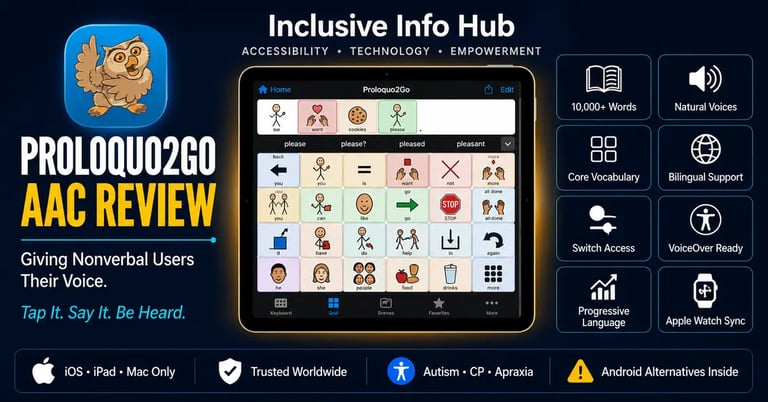
Proloquo2Go is an award-winning AAC app developed by AssistiveWare that enables nonspeaking children and adults to express themselves confidently and initiate conversations. It is a symbol-based communication system: users tap pictures and words arranged on a grid, and the app speaks the resulting sentence aloud in a natural-sounding voice.
It is probably the most complete Augmentative and Alternative Communication app available, used to support people with autism, cerebral palsy, Down syndrome, apraxia, aphasia, and traumatic brain injury — covering a vast range of conditions that share one common thread: the gap between what someone understands and what they can physically say.
The app's vocabulary system, called Crescendo, is built on research showing that just 200 to 400 core words make up around 80 percent of everyday communication, with access to a fringe vocabulary of more than 10,000 additional words for unlimited language growth. This research-based design means a user is not just pointing at random pictures — they are learning a structured language system that mirrors how communication actually develops.
Why Proloquo2Go Is Different From a Simple Picture Board
Plenty of low-cost picture communication tools exist. What separates Proloquo2Go from a basic symbol chart taped to a wall is the depth of thought behind how language is organized and how it grows with the user over time.
Progressive Language gradually reveals new words and grid complexity as a user's communication ability expands, meaning a four-year-old just starting out and a sixteen-year-old building complex sentences can both use the same underlying app at completely different stages of sophistication. The system grows with the person instead of requiring them to graduate to an entirely new tool.
The text-to-speech engine uses over 100 downloadable adult and children's voices, including genuine children's voices recorded specifically for young AAC users — which matters more than it might initially sound. A five-year-old speaking through a flat adult male robotic voice creates a strange social mismatch every time he communicates. Hearing a voice that actually sounds like a child changes how peers and strangers respond to him.
A particularly meaningful recent addition: AssistiveWare released Tamira, the first African American English digital voice designed specifically for AAC, in direct response to the long-standing absence of vocal diversity in synthetic speech technology. It is a small detail in a spec sheet that represents something larger — the recognition that the voice someone is given matters to their identity, not just their function.
Who Proloquo2Go Is Built For
Children and Adults With Autism
For many autistic individuals who are nonspeaking or have limited verbal output, Proloquo2Go provides a reliable, consistent communication method that does not depend on the unpredictability of spoken language production. The structured, visual nature of symbol-based communication aligns well with how many autistic users process and organize information.
Children With Cerebral Palsy and Motor Planning Difficulties
Proloquo2Go can support users with motor or vision disabilities through extensive accessibility accommodations — switch scanning, head tracking, eye tracking, and assistive touch are all supported, meaning a user with significant physical limitations can still access the full system through whatever input method works for their body.
Individuals With Apraxia of Speech
Apraxia disrupts the brain's ability to coordinate the precise muscle movements speech requires, even when the person knows exactly what they want to say. Proloquo2Go bypasses that broken pathway entirely — communication happens through tapping rather than through the motor planning process that apraxia interrupts.
Stroke Survivors and Adults With Aphasia
For adults who develop aphasia after a stroke or brain injury, Proloquo2Go offers a route back to expressive communication that does not require relearning speech from the ground up. The fringe vocabulary and customization options allow the app to be tailored toward adult, situationally relevant language rather than child-oriented content.
Key Features Worth Knowing
Crescendo Core Vocabulary — the research-backed word system built around the most frequently used words in everyday communication, organized for fast, intuitive access.
Bilingual and Multilingual Support — the app supports use across English, Spanish, French, and Dutch, with the underlying grid able to display multiple languages for bilingual households, though it does not yet extend to Urdu, Hindi, or most South Asian languages, which remains a significant gap.
Full Accessibility Accommodations — switch scanning, head tracking, eye tracking, and VoiceOver compatibility mean the app is not limited to users with fine motor control.
Apple Watch Integration — vocabulary can be accessed on a paired Apple Watch, giving users a more discreet and portable communication option outside of carrying a full iPad.
Social Media and Messaging Connectivity — messages built within the app can be sent directly to Facebook, Twitter, email, or text messaging, allowing communication to extend naturally beyond face-to-face conversation. One parent described the moment her nonspeaking child sent her a message reading "Hi Mum, how are you today?" directly from the classroom as one of the most meaningful moments of her life — a sentence sent unprompted, completely independently.
Comprehensive After-Sale Support — one of the most common reasons AAC devices get abandoned by families is a lack of ongoing support once the system is purchased. AssistiveWare maintains active learning resources, a structured Core Word Classroom curriculum, and a genuinely large community of parents and clinicians who provide peer support — addressing exactly the gap that causes families to give up on AAC technology after the initial purchase.
That sustained support layer is, quietly, one of the most important things separating a tool that gets used daily from one that gets downloaded once and forgotten.
The Honest Limitation Every Family Needs to Know Before Buying
This is the most important section of this review, and it needs to be stated plainly and upfront rather than buried at the end.
Proloquo2Go is only available on iPhone, iPad, Mac, and Apple Watch. There is no Android version, and AssistiveWare has given no indication that one is coming. Popular AAC apps including Proloquo2Go, TouchChat, and TD Snap are simply not available on Google Play and can only be used on Apple devices — this is true of nearly every major clinically established AAC app on the market, not a limitation unique to Proloquo2Go.
This is not a small inconvenience. For a family in Lahore, Karachi, Dhaka, or anywhere across South and Southeast Asia where an iPad represents a major financial commitment well beyond an equivalent Android tablet, this single platform restriction can be the difference between a child getting AAC support and going without it entirely.
The cost compounds this further. Proloquo2Go costs $249.99 for iPhone and iPad, and $124.99 for Mac. For families in lower-income economies, this is a genuinely significant expense — particularly when an Android tablet capable of running an alternative app might cost a fraction of an iPad's price, before the app cost is even added.
It needs to be said honestly: this platform exclusivity is not a flaw unique to AssistiveWare. It reflects a broader pattern across the entire AAC software industry, where most developers built their first products for iPad because schools and clinics adopted iPads heavily in the early 2010s, and the entire professional ecosystem — speech-language pathologists, school procurement systems, clinical training — grew up around that platform. Developing for Android is also genuinely more complex, given the huge range of device manufacturers, screen sizes, and processors compared to Apple's much smaller, more controlled hardware lineup.
That history explains the gap. It does not close it for the families who need a solution today.
Pricing Breakdown
Proloquo2Go costs $249.99 as a one-time purchase for iPhone and iPad, or $124.99 for the Mac version. There is no subscription model — once purchased, updates are included.
AssistiveWare offers a 50 percent discount when schools purchase 20 copies or more through Apple's Educational Volume Purchase Program, making institutional adoption significantly more affordable than individual family purchases.
For families pursuing funding support, AAC funding eligibility and programs vary significantly by country and region — families in the US, UK, and Canada should check with national disability funding bodies, while families in Pakistan and South Asia will generally need to explore NGO-based assistive technology grants, as government-funded AAC procurement infrastructure remains limited across much of the region.
If You Don't Have an iPad: The Best Android AAC Alternatives
This is the section most reviews skip entirely, and it is the one that matters most for a significant share of readers of this article. If Proloquo2Go is out of reach because your family uses Android devices, you are not without options. A new generation of AAC apps has emerged specifically to serve the Android ecosystem that Apple-first developers have left underserved.
Spoken — Tap to Talk AAC
Spoken is a strong Android-native AAC app built specifically to fill the exact gap left by Proloquo2Go's iOS exclusivity, with a free tier and a premium upgrade priced around $12.99 monthly or $249.99 for a lifetime license. It includes word prediction and a clean, modern interface designed for the Android ecosystem from the ground up rather than ported over from iOS design conventions.
CoughDrop
CoughDrop is a web-based, open-source AAC tool with cloud syncing, full symbol support, and collaborative editing that works across devices — including Android — through any modern web browser, making it one of the most platform-flexible options available regardless of what hardware a family already owns.
Cboard
Cboard is a free, open-source AAC board system accessible through a web browser on virtually any Android device, designed by and for the AAC community with no cost barrier at all — a genuinely important option for families where even a modest subscription fee represents a real obstacle.
LetMeTalk
LetMeTalk is a free, open-source AAC app available directly on Android, built around customizable picture communication boards with text-to-speech output, representing one of the most accessible zero-cost entry points into AAC technology for Android families.
SabiKo AAC
SabiKo is part of a newer wave of Android-first AAC apps built specifically because so many families were left without options, offering symbol-based communication with ongoing development specifically focused on closing the Android AAC gap that companies like AssistiveWare have not addressed.
👉 A full dedicated comparison of the best Android AAC apps for nonverbal users is coming soon on Inclusive Info Hub — bookmark this page.
Proloquo2Go vs the Competition on iOS
For families who do have access to an iPad and are deciding between Proloquo2Go and its closest iOS competitors, a brief honest comparison is worth including.
TouchChat with WordPower is frequently recommended by speech-language pathologists, particularly because it matches the vocabulary layout used on the NovaChat dedicated AAC hardware devices that many schools already use — meaning a child transitioning between a school-issued device and a personal iPad experiences less disruption in vocabulary location. TouchChat is priced similarly to Proloquo2Go and is iPad exclusive.
LAMP Words for Life uses a different underlying methodology called motor learning, where the physical location of each word never changes, building muscle memory for communication the same way a person builds muscle memory for typing on a keyboard without looking. This approach tends to work particularly well for users with strong motor memory but more limited language processing ability.
Proloquo, a newer subscription-based app from the same developer as Proloquo2Go, is designed for users who can navigate an iPad independently and offers a more streamlined, pre-planned vocabulary structure — though AssistiveWare itself notes that Proloquo is not intended for people with vision or motor issues, for whom Proloquo2Go remains the better choice specifically because of its deeper customization and physical access accommodations.
Frequently Asked Questions
Is Proloquo2Go available on Android or Google Play? No. Proloquo2Go is exclusively available on iPhone, iPad, Mac, and Apple Watch. There is currently no Android version, and the developer has not announced plans to release one. Families using Android devices should consider alternatives such as Spoken, CoughDrop, Cboard, or LetMeTalk.
What is the correct name to search for Proloquo2Go on the App Store? The app appears on the Apple App Store as "Proloquo2Go AAC." Searching simply "Proloquo2Go" also returns the correct listing, but the full official store name includes the "AAC" suffix.
Is Proloquo2Go worth the $249.99 price? For families with access to an iPad, most clinicians and long-term users describe it as worth the investment given its research-backed vocabulary system, extensive accessibility accommodations, and strong ongoing developer support — factors that significantly reduce the well-documented problem of AAC device abandonment.
Can Proloquo2Go be used by adults, not just children? Yes. While many AAC apps are marketed primarily toward children, Proloquo2Go is used by both children and adults, including stroke survivors with aphasia and adults with cerebral palsy or apraxia, with vocabulary fully customizable toward adult, age-appropriate language.
Does Proloquo2Go support Urdu or other South Asian languages? Not currently. The app supports English, Spanish, French, and Dutch. Families needing AAC support in Urdu, Hindi, Bengali, or other South Asian languages will need to explore custom symbol board creation through open-source alternatives like Cboard, which allow for greater language customization.
What This Means for Families in Pakistan and Across Asia
Whether you are a parent in Lahore searching for communication support for a nonspeaking child, or a speech therapist in Karachi building a caseload of AAC recommendations across a school district, the honest reality is that the most clinically established AAC app in the world remains locked behind a hardware ecosystem that is financially out of reach for the majority of families in the region.
This is worth naming directly rather than glossing over with optimism. The good news sits alongside that honest limitation: the Android-first AAC apps covered above — particularly free, open-source options like Cboard and LetMeTalk — have matured significantly and now offer genuinely usable communication support without requiring a family to first purchase Apple hardware they may never have considered buying for any other reason.
For schools, NGOs, and disability support organizations across Pakistan and South Asia working with nonspeaking students, building institutional knowledge around these Android-compatible alternatives is some of the most directly impactful advocacy work available — closing a gap that the largest AAC companies in the world have, so far, left unaddressed.
A Closing Thought
There is a particular kind of moment that AAC technology makes possible — a child saying "I love you" to a parent for the first time, not through a hug or a look, but through actual words they chose and built themselves. Proloquo2Go has made that moment possible for hundreds of thousands of nonspeaking people worldwide. It is, by every reasonable measure, an exceptional piece of technology.
It is also, undeniably, a tool that the families who need it most in Pakistan and across much of Asia frequently cannot access — not because the technology fails them, but because the hardware ecosystem around it was never built with their economic reality in mind. Both of these things are true at once, and an honest review has to hold them together rather than choosing one and ignoring the other.
If an iPad is within reach, Proloquo2Go remains one of the most thoroughly researched and clinically trusted communication tools available anywhere. If it is not, the Android alternatives above are not a consolation prize — they are a genuinely viable path to the exact same outcome: a voice, finally, for someone who has always had something to say.
Read More on Inclusive Info Hub
👉 Otter.ai — AI transcription for deaf and hard of hearing students