Cboard AAC Review 2026: The Free, Open-Source Communication Board Built for Every Child on Earth
Cboard AAC is a free, open-source symbol-based communication app for children and adults with autism, cerebral palsy, and speech impairments. Available on web, iOS, and Android in 40+ languages — including Arabic. Full 2026 review for families in Pakistan, Asia, and globally.
APPS FOR IDD SUPPORTLATEST TECHNOLOGYEDUCATION
Inclusive Info Hub
According to UNICEF, an estimated 240 million children worldwide live with some form of disability — and communication disabilities represent one of the most isolating among them. At Inclusive Info Hub, every AAC tool reviewed here is measured by one standard above all others: does it actually reach the children who need it most, or only the ones whose families can afford to pay for it.
There is a story behind Cboard that almost no other AAC app can match. In 2015, Martin Bedouret, a software developer living in Córdoba, Argentina, was diagnosed with ALS. As his own speech began to deteriorate, he started working with a speech therapist at a rehabilitation center and encountered the same gap that millions of families encounter every single day — the AAC tools available were either too basic to be genuinely useful, or too complex and too expensive to be realistically accessible. So Martin, along with an Israeli programmer, decided to build something different. Something free. Something open-source. Something that could be adapted to any user's needs anywhere in the world.
That decision — made by a man who was losing his own voice — became Cboard. And what started as one developer's personal response to a gap in the market eventually attracted the backing of UNICEF, grew into a global open-source community, and reached children in Timor-Leste, the Balkans, Argentina, and dozens of countries far beyond anything Martin's original vision could have anticipated.
What Is Cboard AAC?
Cboard is an open-source web app for children and adults with speech and language impairments, aiding communication with symbols and text-to-speech. Unlike most AAC apps which are built as native applications for a single platform, Cboard is fundamentally a web application — it runs inside any modern browser on any device, whether that is a desktop computer, a Chromebook, an Android tablet, an iPhone, or a basic smartphone with internet access.
Offline support is available on Google Chrome on desktop and Android. The app uses the browser's built-in Speech Synthesis API to generate speech when a symbol is selected, meaning it does not necessarily require a separate voice engine download to begin functioning.
The app is completely free. Cboard is funded by UNICEF. The team is an international group of professionals whose sole goal is to develop a free and open-source communication aid for people around the world.
That UNICEF backing is not a minor footnote. It means Cboard has been deployed in formal humanitarian programs across developing countries — not as a pilot project or a charitable donation, but as infrastructure. When UNICEF describes a child receiving "a voice" through Cboard, they mean it literally.
The Origin Story That Every AAC Family Should Know
Most AAC apps are built by companies. Proloquo2Go was built by AssistiveWare, a Dutch assistive technology company. TouchChat was built by PRC-Saltillo, a major AAC hardware manufacturer. These are professional products built by professional teams with commercial funding models.
Cboard co-founder and developer Martin Bedouret began the project after being diagnosed with ALS in 2015. The idea stemmed from a conversation with his speech therapist at a rehabilitation center in Córdoba, Argentina, where the AAC options available were either very basic or very complex. The motivation behind Cboard was the need to create an option that could be easily adapted for the needs of each and every user — adding complexity to boards or keeping them simple. Another central aspect to the project was ensuring accessibility, and in order to do so the app had to be free and open-source.
This origin matters because it shapes what Cboard prioritizes. A man who was personally losing his ability to speak did not build a product for a niche premium market. He built something he needed himself — something that anyone, anywhere, at any income level, on any device, could access without permission from an institution or a budget from a government program.
UNICEF's "For Every Child, a Voice" Program
The relationship between Cboard and UNICEF deserves its own section because it gives this app a credibility and reach that no commercial AAC tool can claim.
Cboard, with UNICEF Timor-Leste and Microsoft, ran a four-month pilot between September and December 2023 using PIADS (Psychosocial Impact of Assistive Devices Scale) to measure impact across three schools in Dili and Baucau. PicSeePal donated 60 devices to support schools. Evaluations included surveys and observations.
A separate case study focuses on UNICEF's work supporting open-source AAC tools like Cboard in Balkan countries to provide affordable communication aids for children and build local early intervention capacity.
This is what institutional backing at the UNICEF level looks like in practice — not just a logo on a website, but actual deployment in schools, actual children in Timor-Leste and the Balkans receiving access to communication tools they would otherwise never have reached. The GitHub repository for Cboard even contains a video of Srna, one of the children who received a Cboard Communicator through UNICEF's program, as a human reminder of what the code actually does in the world.
Who Cboard Is Built For
Children and Adults With Autism Spectrum Disorder
Cboard's symbol-based communication grid, customizable board complexity, and browser-based accessibility make it a natural fit for autistic users across a wide range of communication needs. The ability to start with a very simple board of a few symbols and progressively add complexity as the user's communication skills develop mirrors the evidence-based approach that SLPs use in building AAC systems for autistic users over time.
Children With Cerebral Palsy
Cboard is an augmentative and alternative communication web application allowing users with speech and language impairments including autism and cerebral palsy to communicate with symbols and text-to-speech. The large, tappable symbol buttons and customizable grid sizes make the interface accessible to users with varying degrees of motor control, and the browser-based architecture means it can be used with external switch interfaces or keyboard navigation for users with significant physical limitations.
Users With Down Syndrome, Aphasia, and Other Communication Differences
Cboard is designed to develop language in children with speech impairments such as autism, cerebral palsy, and Down syndrome, supporting educational levels from early childhood to upper secondary. Adults with acquired aphasia after stroke or brain injury can also benefit from the customizable board system, particularly its ability to be personalized for adult-appropriate vocabulary and contexts.
Families With No Budget for Commercial AAC
This is the user group that Cboard's entire design philosophy centers on. A family with no money for Proloquo2Go, no iPad to run it on, and no institutional support system has exactly one word to describe Cboard: available. It runs in any browser, on any device, for free, and it works right now.
Key Features at a Glance
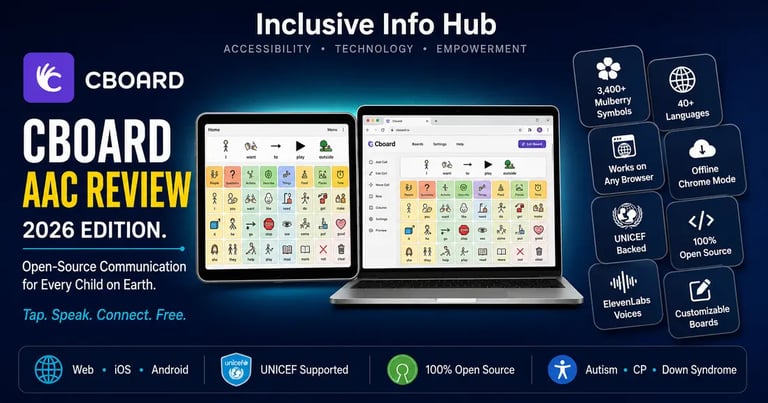
3,400+ Mulberry Symbols — the app uses symbols from the Mulberry Symbol Set, a well-established, freely licensed symbol library widely used in AAC systems internationally. The breadth of available symbols covers communication needs across home, school, healthcare, community, and daily living contexts.
40+ Language Support — Cboard comes with support for 44 languages and counting. This is one of the most significant differentiators from commercially developed AAC apps, which typically prioritize English and a small selection of European languages. Cboard's language range includes Arabic — which is directly relevant for families in Pakistan, the Middle East, and across the Arabic-speaking world. Support quality varies by language since translations are community-contributed, but the breadth of languages available is genuinely unmatched in free AAC tools.
Fully Customizable Boards — users can delete, add, or rearrange symbols through the settings section, create multiple boards for different situations and contexts, and share board configurations with other devices or caregivers. The goal was to create an AAC technology that could be easily adapted to the needs of each user, allowing individuals to personalize their boards by adding or deleting anything they did not need.
Offline Mode on Chrome — offline support is available on Google Chrome on desktop and Android. Once loaded in Chrome, Cboard can continue functioning without an internet connection through the browser's Service Worker caching mechanism. Board customization may still require connectivity for syncing, but core communication functionality works offline — which matters enormously for users in areas with inconsistent internet access.
ElevenLabs Voice Integration — one of the most significant recent updates to Cboard is the integration of ElevenLabs voices, which are among the most natural-sounding AI-generated voices currently available. This is a meaningful upgrade from the basic browser Speech Synthesis API voices that earlier versions relied on entirely, and it brings Cboard's voice quality significantly closer to premium commercial alternatives.
Data-Driven Continuous Improvement — Cboard tracks how often and how long users interact with different features, including symbol selection, text-to-speech usage, and customization options. Analysis revealed users struggled with finding specific symbols, leading to a reorganization of symbols into more intuitive categories and enhanced search functionality. This evidence-based iteration process reflects a product team that is genuinely responsive to real user behavior rather than building features in isolation.
Profile Sharing and Multi-Device Sync — boards and user profiles can be shared between devices, allowing a child's communication setup to be consistent across home, school, and therapy environments — which SLPs consistently identify as one of the most important factors in AAC success.
Web-First Architecture Means No App Store Required — because Cboard runs in any modern browser, a user in a country where Play Store access or App Store billing is complicated can simply navigate to cboard.io and start using it immediately without any installation process.
Pricing — An Honest and Important Update
This is a section that requires direct clarity, because the pricing situation has changed from what many older reviews describe.
Cboard offers a free version, though to access all features a monthly or annual payment is required in certain countries. Cboard was previously free for almost six years. However, to continue efforts to improve and support the addition of more features, the decision was made to begin charging a fee for Cboard.
This transition from entirely free to a freemium model is recent and reflects the reality that maintaining and improving an AAC platform at global scale requires sustainable funding, even for an open-source project. The core communication functionality remains free — and the open-source nature of the codebase means the basic product can never be locked entirely behind a paywall. But families expecting the full feature set at zero cost should be aware that some advanced features now require a paid subscription in certain regions.
For families in Pakistan and across South Asia where budget constraints are real, the free tier of Cboard remains one of the most capable zero-cost AAC options available anywhere. The fact that the core functionality — symbol selection, text-to-speech, board customization, offline Chrome mode — remains accessible without payment means the freemium transition has not eliminated Cboard's most fundamental accessibility value.
For schools, NGOs, and institutions deploying Cboard at scale, direct contact with the Cboard team through cboard.io is recommended to discuss educational and humanitarian pricing arrangements, as UNICEF-partnered programs have demonstrated that institutional deployment pathways exist outside the standard commercial pricing structure.
Cboard vs SabiKo: How They Compare
Both Cboard and SabiKo are free, open-source, symbol-based AAC apps available on Android. For families choosing between them, the honest comparison is as follows.
SabiKo offers more polished native app performance, 37 neural voices on the free tier, stronger offline reliability, and a more modern interface — but supports only five languages and has no Arabic or South Asian language option.
Cboard offers 40-plus language support including Arabic, browser-based cross-platform access with no installation required, UNICEF-validated humanitarian deployment experience, and a customizable symbol library. Its interface is less polished than SabiKo's native app experience, and its freemium transition means some features require payment in certain regions.
For a family in Pakistan where Arabic or another non-Western language is a factor, Cboard's language breadth is a genuine advantage. For a family prioritizing the most polished offline experience on an Android device with English as the communication language, SabiKo's native app experience may be stronger.
👉 We have written a full in-depth review of SabiKo AAC, the free Android-first AAC alternative.
Read our complete SabiKo AAC review here → [INSERT SABIKO AAC ARTICLE LINK]
👉 We have also reviewed Proloquo2Go, the most established clinical AAC app, and its iOS-only limitations.
Read our complete Proloquo2Go review here → [PROLOQUO2GO ARTICLE LINK]
Honest Limitations
The browser-based architecture is Cboard's greatest strength for accessibility and its most honest limitation for performance. Native apps like SabiKo run smoother, load faster, and have more reliable offline behavior than a web app cached in a browser. For users in time-sensitive communication situations, the slight latency difference between a native app and a web app can matter in practice.
Voice quality from the browser's built-in Speech Synthesis API — which remains the default for users without ElevenLabs integration — is noticeably more robotic than the neural voices available in SabiKo or Spoken. The ElevenLabs integration is an important improvement, but it is a premium-tier feature rather than a default free experience.
The community-translated nature of Cboard's 40-plus language support means translation quality varies considerably between languages. Major languages like Spanish, French, and Arabic have been reviewed more thoroughly than smaller or less-resourced languages. Families using Cboard in Urdu or regional South Asian languages should test the specific language experience carefully before relying on it as a primary communication tool.
The freemium transition, while necessary for sustainability, introduces uncertainty for families who adopted Cboard specifically on the basis of its entirely free model. The open-source nature of the codebase provides a structural guarantee that the core product cannot be locked behind a paywall entirely, but families should check the current pricing structure on cboard.io for their specific region before committing.
App Store and Play Store Details — Verified
Google Play Store: Search "Cboard AAC" — developer listed as Cboard org, package identifier com.unicef.cboard. Free to download. Latest version 1.39.0, updated May 2026.
Apple App Store: Search "AAC Cboard" — same developer, same logo, same features. Available on iPhone and iPad.
Web browser access: Visit cboard.io directly in any modern browser — no installation required on any device. This is the most universally accessible entry point, particularly for users in regions where app store billing is complicated.
Frequently Asked Questions
Is Cboard AAC completely free?
The core communication functionality of Cboard is free. Cboard introduced a paid tier for advanced features in certain countries after operating as entirely free for nearly six years. The open-source codebase guarantees the core product cannot be fully locked behind a paywall, but families should verify current pricing on cboard.io for their specific region.
Is Cboard available in Pakistan and South Asia?
Yes. Cboard is available on the web at cboard.io globally with no regional restrictions, on Google Play as "Cboard AAC," and on the Apple App Store as "AAC Cboard." Its Arabic language support is particularly relevant for families in Pakistan and the broader Arabic-speaking world.
Does Cboard work without internet?
Offline support is available specifically through Google Chrome on desktop and Android. Once loaded in Chrome, the core communication interface continues to function without an active internet connection, though board customization and syncing may require connectivity.
Which is better for a nonverbal child — Cboard or SabiKo?
Both are strong free options but serve slightly different use cases. SabiKo offers a more polished native app experience with better offline reliability and neural voices. Cboard offers broader language support including Arabic, web-browser accessibility with no installation required, and UNICEF-validated humanitarian deployment experience. The best choice depends on the child's specific language needs and the family's device and connectivity situation.
Is Cboard open-source?
Yes. Cboard is 100 percent open-source, with its complete codebase publicly available on GitHub. This means developers, institutions, and researchers can inspect, modify, and deploy it independently.
What This Means for Families in Pakistan and Across Asia
Whether you are a parent in Lahore whose child has been diagnosed with autism and needs AAC support today, a special education teacher in Karachi with a classroom of students on different devices, or an NGO worker in rural Sindh trying to reach families who have never heard the words augmentative and alternative communication — Cboard represents one of the most practically accessible entry points into AAC technology that currently exists.
The Arabic language support, while varying in quality, is a genuine differentiator from most commercial AAC apps that overlook non-Western languages entirely. The web-first architecture means a school that cannot standardize on a single device type — some students on Android tablets, some on desktop computers, some on whatever phone a parent could afford — can still give every student access to the same communication system.
The freemium transition is worth monitoring carefully. For now, the free tier remains functional and useful. The UNICEF backing and open-source structure provide a structural guarantee that Cboard will not disappear behind a paywall entirely. But families who depend on Cboard as a primary communication tool should stay informed about pricing changes in their specific region and consider the free alternatives covered elsewhere on this blog as complementary options rather than pure substitutes.
A Closing Thought
Martin Bedouret started building Cboard while he was losing his own voice. He did not build it for a market segment. He built it because he was sitting in a rehabilitation center in Córdoba, Argentina, and the tools available were either too basic or too expensive, and he had the skills to do something about it.
That is not a typical origin story for a technology product. And Cboard is not a typical AAC app. It is a project that a man started for himself, that a global community of developers and speech professionals continued, that UNICEF deployed in the field, and that children in Timor-Leste, the Balkans, Pakistan, and dozens of countries in between are using today to say things they could not say before.
The technical limitations are real. The freemium transition is worth watching. The voice quality trail behind the best neural voices available on premium platforms. None of that changes what Cboard fundamentally is: one of the most honest expressions of what technology can do when it starts from a principle of access rather than a principle of profit.
For a child who needs to communicate right now, in a family that cannot afford to pay for the privilege of giving them a voice, Cboard is there. That still matters enormously.
Read More on Inclusive Info Hub
👉 Proloquo2Go — the most established AAC app and its Android alternatives: Read our full review here → [https://inclusiveinfohub.com/proloquo2go-review-the-aac-app-giving-nonverbal-users-their-voice-and-what-to-use-if-you-dont-have-an-ipad]
👉 Spoken — Tap to Talk AAC — AI-powered communication for adults with aphasia and speech loss: Read our full review here → [https://inclusiveinfohub.com/spoken-tap-to-talk-aac-review-2026-the-android-first-voice-for-adults-who-cant-speak]
👉 Best AI Accessibility Tools in 2026 — the complete guide across all disability categories: Read our full guide here → [https://inclusiveinfohub.com/best-ai-accessibility-tools-in-2026-how-artificial-intelligence-is-finally-closing-the-access-gap]