
Spoken — Tap to Talk AAC Review 2026: The Android-First Voice for Adults Who Can't Speak
Spoken is a free AI-powered AAC app for Android and iOS that predicts your words and speaks them aloud. This 2026 review covers features, pricing, and why it's a genuine option for adults with aphasia, ALS, and apraxia in Pakistan and Asia.
APPS FOR HI SUPPORTAPPS FOR IDD SUPPORT
Inclusive Info Hub
According to the National Aphasia Association, aphasia alone affects roughly two million people in the United States, and that number does not even begin to account for the millions more worldwide living with ALS, apraxia, stroke-related speech loss, and nonverbal autism. At Inclusive Info Hub, every AAC app reviewed here is judged against one real-world question: does it actually give someone their voice back, fast enough and affordably enough to use today, not eventually.
Imagine a father in his fifties, three months after a stroke, sitting at the dinner table with his family. He understands every word being said around him. He has opinions about the food, a joke about his grandson's haircut, a question about tomorrow's doctor's appointment. None of it comes out the way it used to. Speech therapy is helping, slowly, but slow is not what a dinner table conversation needs.
This is the exact gap Spoken — Tap to Talk AAC was built to close, and it does so with a design philosophy that looks meaningfully different from the symbol-grid AAC apps most people picture when they hear the term assistive communication.
What Is Spoken — Tap to Talk AAC?
Spoken is an AI-powered augmentative and alternative communication app designed for people who are unable to use their voice due to nonverbal autism, aphasia, stroke, ALS, Parkinson's, cerebral palsy, or other speech and language disorders. Rather than relying primarily on symbol grids the way Proloquo2Go and similar apps do, Spoken centers its entire design around fast, intelligent word prediction — closer in feel to how a smartphone keyboard predicts your next word, but purpose-built for full spoken communication rather than just text messaging.
It is an entirely new kind of AAC that uses artificial intelligence to learn from how a person talks and predicts the words they are likely to want next, with the goal of speeding up the painfully slow process that traditional AAC communication often involves. For users who are literate and primarily need help with speech production rather than language comprehension — which describes a large share of adults with aphasia, ALS, and Parkinson's — this prediction-first approach can dramatically increase the pace of real conversation.
How Spoken Actually Works
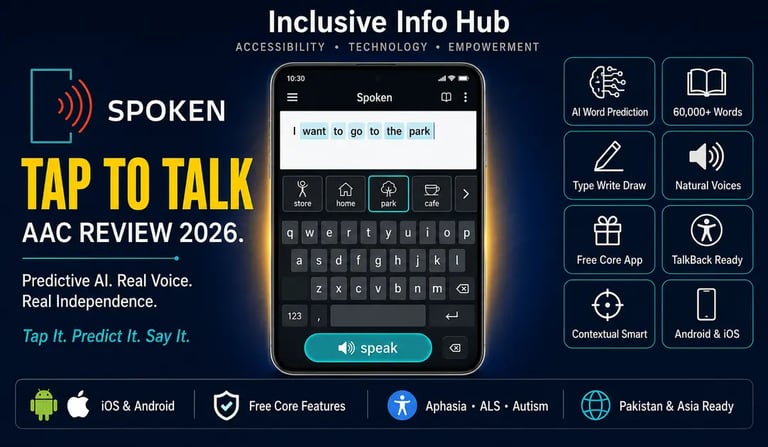
The core interaction is refreshingly simple to describe, even though the underlying AI is sophisticated. A user begins typing, writing, or drawing a word, and Spoken offers a scrollable list of word suggestions paired with icons for quick visual recognition — unlike the basic predictive text built into most smartphone keyboards, which only suggests one or two words at a time with no visual support.
What makes the prediction genuinely useful rather than just a novelty is its contextual intelligence. Spoken can adapt its suggestions to your location — visit a restaurant, and words like appetizers, dessert, and drinks become more likely suggestions; visit a hospital, and the predicted vocabulary shifts accordingly. This location-aware prediction means a user is not wading through generic word lists every single time — the app is actively narrowing the search based on where the conversation is actually happening.
Spoken also supports personalized predictions, where a user can teach the app basic information about themselves — names of family members, friends, pets, and frequently visited places — so the system begins suggesting those specific names rather than generic placeholders. A father using the app to talk to his grandchildren does not want to search through a generic word list to find "Sara" — he wants her name to simply appear because the app has learned who matters in his life.
Beyond typing, the app supports three input methods: typing, handwriting on a canvas, and drawing — all three converting directly to speech, giving users flexibility based on what physical input method is most comfortable or accessible to them on a given day.
By default, Spoken already knows over 60,000 words, and it continues learning new vocabulary directly from how each individual user types and communicates, meaning the prediction engine becomes more personally accurate the longer someone uses it.
Who Spoken Is Genuinely Built For
Adults With Aphasia After Stroke
This is arguably where Spoken's design philosophy shines brightest. Adults with aphasia frequently retain strong literacy and language comprehension even when speech production is severely affected — meaning a typing-and-prediction-based system, rather than a child-oriented picture-symbol grid, matches their actual cognitive profile far more naturally. A father at that dinner table is not relearning what a fork is. He needs speed, dignity, and an interface that does not feel infantilizing.
People Living With ALS and Progressive Speech Loss
For individuals with ALS, speech often deteriorates gradually rather than disappearing all at once, which makes a flexible, multi-input system genuinely valuable. As physical capability changes over time, a user can shift between typing, handwriting, and drawing depending on what motor function remains accessible on a given day — without needing to switch to an entirely different app or relearn a new system mid-diagnosis.
Nonverbal Autistic Teens and Adults Who Are Literate
For autistic individuals who can read and type but cannot reliably produce spoken language, Spoken offers a more age-appropriate, less child-coded interface than many symbol-based AAC systems originally designed with young children in mind. A sixteen-year-old or an adult does not always want to communicate through cartoon-style picture icons — Spoken's text-first, prediction-driven approach can feel considerably more dignified for older nonspeaking users.
People With Parkinson's Disease
As Parkinson's progresses and affects speech clarity and volume, Spoken provides a reliable fallback communication method that does not depend on vocal cord control at all — useful in situations where speaking aloud has become physically exhausting or difficult for others to understand.
Key Features Worth Knowing
AI-Powered Predictive Text — the centerpiece of the app, learning from each user's individual speech and typing patterns to surface increasingly accurate word suggestions over time, paired with recognizable icons for faster visual scanning.
Three Input Methods — typing, handwriting, and drawing, all converting directly to spoken output, giving flexibility as a user's physical capabilities change.
Get Attention Quickly — a customizable alert feature that lets a user grab someone's attention with a single tap, whether in an emergency or simply to signal readiness to communicate — a small feature with outsized real-world importance for users who cannot call out across a room.
Acapela Voice Compatibility — Spoken supports setting Acapela text-to-speech as the Android system's preferred voice engine, unlocking access to a wider range of natural-sounding voice options beyond the device's default robotic voice.
Full TalkBack and Screen Reader Optimization — the app has been specifically overhauled for TalkBack and screen reader users, addressing accessibility needs that extend beyond speech production alone, including users with combined vision and speech impairments.
Contextual and Location-Aware Predictions — as described above, this is one of the more genuinely innovative features in the current AAC app landscape, and it directly addresses one of the most common frustrations with traditional AAC systems: irrelevant, generic word suggestions that slow communication down rather than speeding it up.
Pricing: What Spoken Actually Costs
This is where Spoken distinguishes itself most clearly from Proloquo2Go and other major iOS-exclusive AAC apps, and it matters enormously for the audience this blog serves.
The core functionality of Spoken always remains free of charge, meaning a user can speak using the app whether or not they ever upgrade to Premium. All new users are automatically enrolled in a complimentary trial of Spoken Premium, which unlocks the full range of personalized predictions and natural-sounding voice options, and when the trial ends, users are simply asked whether they want to subscribe — the core communication functionality does not disappear.
Spoken Premium itself is available at $12.99 per month, $99.99 per year, or as a one-time lifetime purchase of $249.99. The lifetime option notably matches Proloquo2Go's one-time pricing almost exactly — but Spoken's free tier means a family or individual who cannot afford even that lifetime fee still retains a genuinely functional communication tool at zero cost indefinitely.
That free-forever core tier is, frankly, one of the most important details in this entire review for readers in Pakistan and across South Asia, where a $249.99 one-time AAC purchase — let alone a recurring monthly subscription — represents a serious financial barrier for the majority of families.
Click to download SPOKEN on Play Store
How Spoken Compares to Proloquo2Go
It would be incomplete to review Spoken without directly addressing how it stacks up against the AAC app most people search for first.
The most immediate and practical difference: Spoken is available on both Android and iOS, while Proloquo2Go remains exclusively locked to iPhone, iPad, Mac, and Apple Watch. For families across Pakistan and Asia where Android devices dominate the market by a wide margin, this single difference alone makes Spoken meaningfully more accessible from day one.
👉 We have written a full in-depth review of Proloquo2Go, including a complete breakdown of Android AAC alternatives.
Read our complete Proloquo2Go review here
The second meaningful difference is design philosophy rather than platform. Proloquo2Go is fundamentally a symbol-based system built around a structured core vocabulary, originally designed with strong consideration for young children and users with significant cognitive or motor differences. Spoken is fundamentally a text-and-prediction-based system, better matched to literate users — particularly adults with aphasia, ALS, or Parkinson's — who need speed and dignity more than symbol-based language scaffolding.
Neither approach is universally superior. They are built for genuinely different primary users, and many speech-language pathologists recommend different AAC systems for a young nonverbal child with autism versus an adult stroke survivor with intact literacy — exactly because the underlying cognitive and communication needs are not the same.
Honest Limitations
Spoken's prediction-based, text-first design is its greatest strength for literate adult users, and simultaneously its clearest limitation for young children or users who cannot yet read fluently. A four-year-old who has never learned to read will gain far less from a predictive text engine than from a structured, age-appropriate symbol grid — which is exactly where an app like Proloquo2Go remains the stronger fit.
The Premium subscription pricing, while reasonable compared to one-time AAC software purchases generally, can still accumulate meaningfully over time on the monthly plan, and the lifetime purchase option is currently only available through the developer's own website rather than directly through the app stores — an extra step that can create friction for less tech-comfortable users or caregivers.
While the app supports a wide range of natural-sounding voices, language support beyond English remains limited compared to some competitors like Predictable, which supports 43 languages. For Urdu, Hindi, Bengali, or other South Asian language communication needs, Spoken's English-centered design may not fully meet every family's requirements.
Frequently Asked Questions
Is Spoken — Tap to Talk AAC free to use? Yes. The core communication functionality of Spoken always remains free, with an optional Premium subscription unlocking advanced personalized predictions and additional natural-sounding voices. This makes it one of the most financially accessible full-featured AAC apps currently available for Android users.
Is Spoken available in Pakistan and South Asia? Yes. Spoken is available on both the Apple App Store and Google Play Store globally, including Pakistan, India, Bangladesh, and across South and Southeast Asia, with no regional restrictions on the free core app.
Is Spoken better than Proloquo2Go? Neither app is universally better — they serve different primary users. Spoken's text-prediction approach suits literate adults with aphasia, ALS, or Parkinson's particularly well, while Proloquo2Go's symbol-based system tends to be stronger for young children and users with significant cognitive or motor differences who are not yet reading fluently.
Does Spoken work for nonverbal autistic adults? Yes, particularly for autistic individuals who are literate and can type or write but struggle with spoken language production. The app's less child-coded, text-first interface is often considered more age-appropriate for autistic teens and adults compared to symbol-grid systems designed primarily for younger children.
Can Spoken be used offline? Spoken's core typing-to-speech functionality works without requiring constant internet connectivity for basic use, though some advanced AI prediction features and voice downloads benefit from an internet connection, particularly during initial setup.
What This Means for Families in Pakistan and Across Asia
Whether you are caring for a parent recovering from a stroke in Lahore, supporting a sibling with ALS in Karachi, or working as a speech-language therapist in Dhaka building a caseload for adult clients with acquired speech loss, Spoken represents something genuinely rare in the AAC technology space: a clinically credible, AI-powered communication app that does not require an iPad purchase as a prerequisite for access.
The honest reality is that most of the AAC apps with the longest clinical track records — Proloquo2Go, TouchChat, LAMP Words for Life — remain locked to Apple's ecosystem, creating a real and well-documented access gap for Android-majority markets across South Asia. Spoken does not fully replace those tools for every user, particularly young children needing symbol-based language scaffolding, but for adult users with intact literacy and progressive or acquired speech conditions, it closes a meaningful part of that gap today, for free, on the device most families already own.
A Closing Thought
There is something quietly powerful about a man, three months after a stroke, typing two letters and watching the right word — his grandson's name — appear before he has to search for it. Not because the app is flashy. Because it learned him.
Spoken does not promise to restore speech. No AAC app does. What it offers instead is something narrower and, in its own way, more honest: a fast, dignified, increasingly personalized way back into conversations that illness or disability tried to take away. For a family in Pakistan weighing whether assistive communication technology is even within reach, the answer — at least with Spoken — is genuinely yes, starting today, at no cost at all.
Read More on Inclusive Info Hub
👉 Proloquo2Go — the most established AAC app, and the Android alternatives families should know about.........
👉 Best AI Accessibility Tools in 2026 — including the AI voice technology powering apps like Spoken
👉 Otter.ai — AI transcription for deaf and hard of hearing students