
Meta Ray-Ban Smart Glasses Review 2026: Hands-Free AI Vision and Hearing Support for Blind and Deaf Users
Meta Ray-Ban Smart Glasses combine AI vision, live translation, and hearing assistance into everyday eyewear. This 2026 review covers accessibility features for blind and deaf users, real pricing, and honest limitations for buyers in Pakistan and Asia.
APPS FOR HI SUPPORTDAILY LIVING APPSNAVIGATION APPS
Inclusive Info Hub
6/21/20269 min read
According to the American Foundation for the Blind, even accessibility tools that were never designed with blind users in mind first can still meaningfully change daily independence — and Meta Ray-Ban Smart Glasses are a striking case study in exactly that. At Inclusive Info Hub, every wearable device reviewed here is judged honestly: not by its marketing, but by whether it genuinely removes a barrier for the person wearing it, every single day, not just in a product demo.
Picture a blind student walking across a university campus, hands completely free — no phone held up, no cane fumbling against a bag strap — simply saying "Hey Meta, look and read what's in front of me" and hearing the answer spoken directly into her ear through the temple of her sunglasses. Picture a deaf or hard of hearing professional in a noisy restaurant, quietly amplifying the voice of the person across the table through the same pair of glasses, without anyone else at the table even noticing.
Neither of these people bought their glasses primarily as an assistive device. That is precisely what makes this review worth writing carefully.
What Are Meta Ray-Ban Smart Glasses?
Meta Ray-Ban Smart Glasses are a line of AI-powered eyewear built in partnership between Meta and Ray-Ban's parent company, combining a built-in camera, open-ear speakers, a multi-microphone array, and Meta's AI assistant into the frame of genuinely stylish, everyday sunglasses and prescription eyewear. Meta now offers four distinct product lines ranging from $299 to $799, expanding from the original camera-and-audio glasses into a newer Display model with an in-lens screen and a wrist-worn Neural Band for gesture control.
The accessibility angle is, refreshingly, not a marketing afterthought bolted onto a tech demo — though Meta did not originally design the product as assistive technology first. As one reviewer from the American Foundation for the Blind put it plainly: the Ray-Ban Meta glasses are an accessibility tool only by coincidence, which makes them more affordable and, in some ways, unaware of the specific needs of users with reduced vision — yet for the price and convenience, they still offer a great deal in object recognition, environmental description, and reading through optical character recognition.
That tension — mainstream consumer product that happens to deliver genuine accessibility value — runs through this entire review.
How the AI Assistant Actually Works for Blind and Low Vision Users
Once paired with a smartphone over Bluetooth through the free Meta AI app, a user issues voice prompts beginning with "Hey Meta." For everyday accessibility use, the two most important commands are deceptively simple: "Hey Meta, look and describe what's in front of me" and "Hey Meta, look and read what's in my hand." In each case, the glasses' camera captures the scene, Meta's AI processes it, and the description or text reading is spoken back through the open-ear speakers within seconds.
This puts the glasses in direct functional territory with apps like Seeing AI and Google Lookout — except the camera is already pointed correctly because it is mounted on the user's face rather than held in an unpredictable hand position. For a blind user, this single design difference solves one of the most persistent frustrations with phone-based OCR and scene description: not knowing whether the camera is actually aimed at the right thing.
👉 We have written full in-depth reviews of Seeing AI and the conceptually similar Be My Eyes as well
Be My Eyes Built Directly Into the Glasses
This is, without question, the single most significant accessibility development associated with this product line. Developed in partnership with Meta engineers, Be My Eyes is the first and only accessibility technology for blind or low vision users available directly on Meta AI Glasses, providing hands-free access to live volunteer calls.
In practice, a user gives a simple voice command, a sighted Be My Eyes volunteer is connected, and that volunteer sees through the point-of-view camera on the glasses while speaking guidance back through the open-ear speakers — completely hands-free from start to finish. One of the most persistent challenges with any smartphone-based accessibility app has always been that it requires at least one, and often two, hands to operate. Mounting the entire interaction on the face removes that requirement entirely.
👉 Full breakdown of the Be My Eyes Smart Glasses integration is included in our Seeing AI vs Be My Eyes comparison
The honest caveat that deserves direct mention: Be My Eyes AI — the GPT-4-powered conversational image description feature — does not currently function through the glasses; only live volunteer calls are supported in this hands-free integration. The instant AI description still requires the phone app directly. The two technologies sit side by side rather than fully merged, at least for now.
Live Translation: A Quietly Powerful Accessibility Feature
Live translation lets a user point their camera at printed text — a menu, a sign, a document — say "Hey Meta, translate this," and receive a readable translation, with conversational back-and-forth translation supported across six languages and counting. For a blind or low vision traveler navigating an unfamiliar country, or simply for a sighted user who wants foreign text read aloud in their own language, this feature blurs the line between mainstream convenience and genuine accessibility tool — exactly the pattern this entire product line follows.
Hearing Support: The Feature Most Reviews Miss Entirely
Most coverage of Meta Ray-Ban glasses focuses heavily on the vision-related AI features, and almost entirely overlooks a genuinely significant hearing accessibility update. Recent software updates introduced a feature that amplifies the voice of the person you are talking to using the open-ear speakers, specifically designed to make conversations clearer in noisy environments such as restaurants, commutes, concerts, and crowded spaces, with an adjustable amplification level controlled by a simple swipe on the right temple.
This positions the glasses as a meaningful, if unofficial, assistive listening device for users with mild to moderate hearing loss who are not ready for or cannot access traditional hearing aids — at a fraction of the cost of dedicated hearing assistance hardware, and in a form factor that carries none of the stigma some users associate with visible hearing aids.
That conversational amplification feature is the kind of quiet, unglamorous addition that does not headline a product launch keynote, but genuinely changes a Tuesday evening at a noisy family dinner for someone who has been struggling to follow the conversation.
Key Features at a Glance
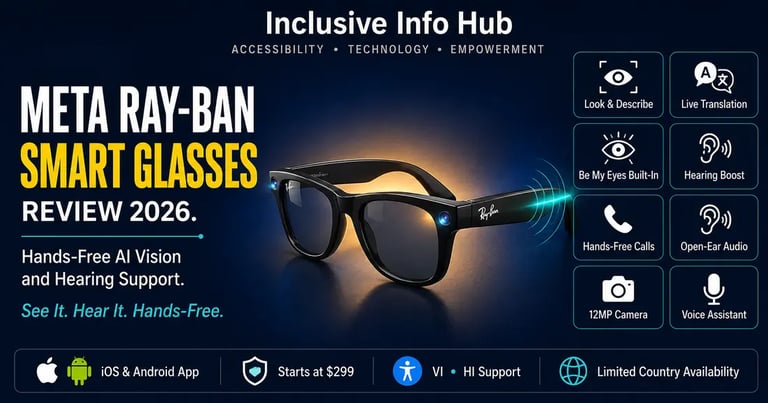
AI Scene Description and OCR Reading — voice-commanded "look and describe" and "look and read" functions powered by Meta AI, processing the camera feed and speaking results aloud.
Be My Eyes Hands-Free Integration — direct access to live sighted volunteers through voice command, with the volunteer seeing through the glasses' point-of-view camera.
Live Translation — real-time translation of printed text and spoken conversation across six languages, fully hands-free.
Conversation Amplification — adjustable hearing-boost feature using open-ear speakers, designed for noisy environments, controlled with a temple swipe gesture.
Hands-Free Navigation — voice-commanded turn-by-turn walking directions, with the newer Display model showing a visual map directly in the lens.
12MP Camera with Up to 3K Video — for users who also want standard photo and video capture, with audio captured through a five-microphone array.
Open-Ear Audio — speakers positioned near the ear without blocking ambient sound or conversation, which matters significantly for blind users who rely on environmental sound cues for safe navigation.
Meta Ray-Ban Display Model — a premium $799 tier adding an in-lens display for notifications, navigation, and live captions, controlled via a wrist-worn Neural Band that reads muscle signals for gesture input — a detail with its own accessibility implication, since wrist muscle signals can provide control input even for users with limited hand mobility or dexterity.
Pricing and Where to Get Them
Ray-Ban Meta AI glasses start at $299 for the standard camera-and-audio model, with the line extending up to $799 for the Display model bundled with the Meta Neural Band. The required Meta AI companion app is a free download from the Apple App Store or Google Play Store, running on iOS 14.2 and above or Android 10 and above.
The glasses themselves are sold through Ray-Ban retail stores, Meta's own online store, and authorized retailers including Best Buy, LensCrafters, and Sunglass Hut, with availability currently concentrated in the United States, Canada, and a small set of additional countries — and expanding gradually rather than launching globally all at once.
Honest Limitations — What This Review Will Not Soften
It would be dishonest to present this product as a purpose-built accessibility device without naming its real constraints clearly.
This is fundamentally a mainstream consumer product, not assistive technology designed first for disabled users. The American Foundation for the Blind's own reviewer noted this directly — the glasses are, in many ways, unaware of the specific needs of users with reduced vision, because accessibility was never the primary design brief. Features that would matter enormously to a blind-first design — like more granular audio feedback during setup, or fully non-visual onboarding — are not guaranteed priorities for Meta's product team the way they would be for a company like Envision or AssistiveWare.
Country availability remains genuinely limited. Be My Eyes on Meta AI Glasses is currently available in a number of countries including Australia, Canada, Ireland, the United Kingdom, the United States, France, Denmark, Germany, India, Italy, Mexico, Spain, and the United Arab Emirates — a list that notably does not yet include Pakistan, Bangladesh, or most of Southeast Asia.
Price remains a real barrier. At $299 to $799, this product sits well outside the reach of the majority of students and families across Pakistan and South Asia, particularly compared to free software-only alternatives that deliver much of the same core AI vision functionality through a phone a family already owns.
Battery life requires realistic expectations. The Display model offers roughly six hours of mixed-use battery life per charge, extended to about 24 hours total with the included charging case — meaning a full day of heavy use without recharging is not guaranteed, particularly for the more power-hungry Display variant.
Be My Eyes AI's instant conversational description does not yet work through the glasses — only live human volunteer calls are currently supported hands-free, with the deeper AI description layer still requiring the phone app directly.
Frequently Asked Questions
Are Meta Ray-Ban Smart Glasses designed for blind users? No, not primarily. They are a mainstream consumer eyewear product with AI features that happen to deliver real accessibility value, including scene description, text reading, and hands-free Be My Eyes volunteer calls. They were not designed accessibility-first the way apps like Envision or dedicated devices like OrCam MyEye were.
Do Meta Ray-Ban glasses work for deaf or hard of hearing users? Partially. A conversation amplification feature using the open-ear speakers helps users hear conversations more clearly in noisy environments, functioning as an informal assistive listening tool, though the glasses are not a substitute for medically prescribed hearing aids or cochlear implants.
Are Meta Ray-Ban Smart Glasses available in Pakistan? Not currently through official retail channels. Availability is concentrated in the US, Canada, UK, and a small number of other countries, with India included in the Be My Eyes integration list but Pakistan not yet officially supported as of this review.
How much do Meta Ray-Ban Smart Glasses cost? The lineup starts at $299 for the standard camera and audio model, extending to $799 for the premium Display model with an in-lens screen and Neural Band wristband.
Can Meta Ray-Ban glasses replace a dedicated accessibility app like Seeing AI? Not entirely. They offer comparable scene description and text reading capability with the convenience of hands-free, face-mounted camera positioning, but Seeing AI remains free, more software-mature, and far more accessible price-wise for users who cannot justify a $299-plus hardware purchase.
What This Means for Students and Professionals in Pakistan and Across Asia
This is the section where honesty matters most. Whether you are a blind student at LUMS in Lahore or a deaf professional working in Karachi, the realistic picture in 2026 is that Meta Ray-Ban Smart Glasses remain, for now, a Tier 1 market product — both in terms of official retail availability and in terms of price relative to regional income levels.
That does not mean this technology is irrelevant to readers in the region. It signals clearly where mainstream consumer AI hardware is heading, and it validates something important: the same underlying AI capability — scene description, OCR reading, live translation, hands-free volunteer calling — already exists in free software form through apps like Seeing AI, Google Lookout, and Be My Eyes' own phone app, all fully available across Pakistan and South Asia today. The hardware convenience of wearing that capability on your face is, for now, a premium add-on rather than the only way to access the underlying technology.
👉 For the free, fully Pakistan-and-Asia-accessible version of this same core AI capability, read our complete guide to the best AI accessibility tools available right now.
A Closing Thought
There is something worth sitting with in the fact that the most hands-free, most genuinely freeing piece of assistive technology covered in this review was never built for disabled users first. Meta built stylish sunglasses with a camera and a voice assistant for a mainstream market, and blind and deaf users found independence inside it anyway — through a feature that happened to exist, used in a way its designers may not have fully anticipated at the outset.
That is not a complete story. Purpose-built accessibility devices, designed from day one around the real needs of blind and deaf users, still matter — arguably more than ever, precisely because mainstream products like this one will always carry the limitations of having been designed for someone else first. But for the blind student walking across a campus with both hands free, or the deaf professional finally following a conversation in a loud restaurant, the distinction between "built for me" and "works for me" matters considerably less in the moment than the simple fact that, for once, it actually does.
Read More on Inclusive Info Hub
👉 Otter.ai — AI transcription and captioning for deaf and hard of hearing students: Read our full review, click here