
SabiKo AAC Review 2026: The Free, Offline, Symbol-Based Communication App That Works on Every Device
SabiKo AAC is a completely free symbol-based communication app for nonverbal users on both Android and iOS. This 2026 review covers 8,400+ symbols, 37 neural voices, offline mode, and why it's the best free Proloquo2Go alternative for families in Pakistan and Asia.
APPS FOR IDD SUPPORTLATEST TECHNOLOGYEDUCATION
Inclusive Info Hub
According to the World Health Organization, between 0.5 and 1 percent of the global population requires some form of augmentative and alternative communication support — which, applied to Pakistan's population of over 230 million people, represents more than one million individuals who may benefit from AAC technology. At Inclusive Info Hub, every AAC app reviewed here is evaluated against one straightforward question: can the family who needs this tool actually access and use it today, without financial barriers or platform gatekeeping standing in the way.
Picture a seven-year-old in Lahore, diagnosed with autism at age three. His therapist recommends Proloquo2Go. His parents search the App Store, find the listing, see the price — $249.99, on iPhone or iPad only, with no Android version, no free tier, and no way to try before committing to a hardware and software package that together cost more than a month's household income. The recommendation made perfect sense. The pathway to following it simply does not exist.
SabiKo was built by people who saw exactly this gap and decided to do something about it. It is a free AAC app that works on both Android and iOS, runs entirely offline, requires no account to set up, and delivers 8,400 symbols and 37 neural voices for nothing — right from the moment you download it. For the families who need AAC the most and have the least room to absorb the costs the mainstream market charges for it, this is not a minor footnote in the AAC landscape. It is genuinely transformative.
What Is SabiKo AAC?
SabiKo is a free AAC app that helps people communicate with natural-sounding voices, 8,400+ symbols, and fully customizable boards. It works offline on iPad, iPhone, and Android and is positioned as a free alternative to Proloquo2Go and TouchChat.
The name SabiKo does not stand for anything technical — it is a name chosen to feel personal, approachable, and human rather than clinical or corporate, which reflects something deliberate about how the team built the product. SabiKo was built to work on both iOS and Android because the developers believe platform should not determine whether a child can communicate. That design principle is not a marketing line — it is the founding reason the app exists, and it shapes every decision visible in the product.
SabiKo gives a voice to individuals who communicate differently, whether due to autism, cerebral palsy, aphasia, speech delays, or any condition that affects spoken language. Built for Android tablets and phones, SabiKo works completely offline — every symbol, every voice, every word, available without an internet connection — because communication should not depend on Wi-Fi.
How SabiKo Works
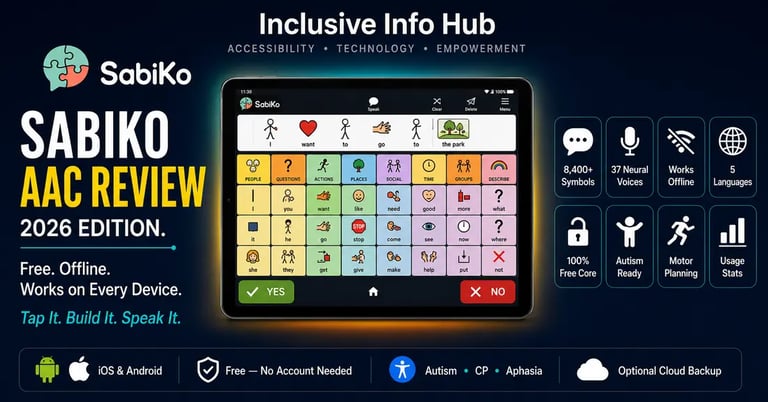
The core interaction follows the same fundamental pattern as other symbol-based AAC apps: a user taps symbols on a customizable grid to build sentences in a strip at the top of the screen, and presses speak to have the sentence read aloud in a natural-sounding voice. What distinguishes SabiKo's implementation of this pattern are the layers of thoughtfulness built around it.
Color-coded buttons make it easy to find words by category. Boards can be customized from a single button up to a 12x12 grid. A user can pick a button size and the grid arranges itself to fit their screen, or set a custom grid layout for full control. Custom words with personal images can be added, words and folders dragged anywhere, and as many pages as needed can be built.
The color coding follows the Fitzgerald Color System — a well-established AAC convention where different parts of speech are consistently assigned different colors, so a user who has learned that orange means verbs and yellow means nouns can navigate any Fitzgerald-coded board without needing to re-learn its layout from scratch. This is not decoration. It is a research-backed approach to reducing the cognitive load of finding words quickly during a real conversation.
A particularly practical design decision: persistent yes/no buttons are always visible on screen, and large touch targets are designed for motor differences. For a user who may have limited motor control, the ability to always confirm or deny something without navigating through menus — without ever losing those two fundamental communication options — is meaningful in exactly the moments when communication is most urgent.
Who SabiKo Is Built For
Nonverbal and Minimally Verbal Children With Autism
This is SabiKo's clearest primary audience, and the one the app's design decisions most visibly reflect. The symbol-based grid layout, the Fitzgerald color coding, the persistent yes/no buttons, the motor-planning-aware board structure with consistent button positions — all of these trace directly back to decades of AAC research on how autistic users build reliable, fast communication habits through repetition and spatial memory.
The core word board layout is based on AAC research involving 56 core words, reflecting the same underlying research that informs Proloquo2Go's Crescendo vocabulary system — that a relatively small set of high-frequency words handles the overwhelming majority of daily communicative needs, and that organizing those words accessibly is more important than having the largest possible vocabulary up front.
Children and Adults With Cerebral Palsy
Large touch targets designed for motor differences and configurable haptic feedback make SabiKo meaningfully more accessible for users with cerebral palsy or other motor planning differences than apps designed primarily for users with no motor considerations. The ability to adjust grid size down to a single large button means a user with limited precise finger control can still communicate effectively.
Adults With Aphasia
For adult users whose speech was disrupted by stroke or brain injury and who retain literacy but need a symbol-based support system alongside text input, SabiKo's built-in spelling keyboard alongside the symbol grid offers both pathways in a single app — the user does not have to choose between a symbol-only system and a text-only system.
Families in Lower-Income Economies
This is the category this blog serves most directly, and the one that distinguishes SabiKo most clearly from the iOS-exclusive premium competitors. A family in Karachi with a nonverbal child, an Android tablet, and no budget for a $249.99 app has a real path to full-featured AAC support with SabiKo today. That is not a small thing.
Key Features — What the Free Tier Actually Includes
This matters enormously and deserves its own focused section, because one of the most common frustrations with freemium apps is discovering that the genuinely useful features are locked behind a paywall and the "free" tier is little more than a marketing demo.
The free tier includes full board communication, 6 neural voices across 5 languages, word prediction, grammar correction, spelling keyboard, core words, quick phrases, visual schedule, choice maker, communication passport, visual timer, and more.
Six neural voices, word prediction, grammar correction, a spelling keyboard, a visual schedule, and a communication passport — all free, all offline, with no account required to access any of it. For context: most competing AAC apps charge $10 to $20 per month for a fraction of this feature set.
SabiKo Pro unlocks all 37 neural voices, statistics and usage dashboard, message history up to 200 entries, custom grid sizes from 1x1 to 12x12, expanded stash up to 50 items, high contrast Fitzgerald color theme, up to 10 profiles per device, per-word pronunciation overrides, sound board, print board, XL button size, vocabulary packs, and custom audio recording on any word or folder.
The Pro tier is where the serious power user features live — and it is priced from approximately $5 per month, making it one of the most affordable premium AAC subscriptions available anywhere in the market.
The Offline-First Architecture — Why This Matters More Than It Sounds
SabiKo runs 100 percent offline. Vocabulary, messages, and personal data stay on the device. Cloud backup is optional and uses the user's own Google account — SabiKo never accesses the data.
In the AAC world, this architecture choice has implications that go beyond simple connectivity. A nonverbal child who depends on their AAC app for communication should never be in a position where their voice disappears because the Wi-Fi went down or cellular data ran out. That dependency is not hypothetical — it is a real and documented problem with cloud-dependent AAC tools.
SabiKo's decision to keep everything local, with cloud backup as an opt-in rather than a requirement, means a family in a rural area of Pakistan with unreliable internet access has exactly the same communication reliability as a family in London with fiber broadband. The app works the same way regardless.
The optional Google account backup means that if a device is lost, broken, or upgraded, a user's carefully built vocabulary, custom boards, and personal settings can be restored rather than rebuilt from scratch — a meaningful reassurance for families who have spent weeks or months customizing their child's communication environment.
SabiKo vs Proloquo2Go: The Honest Comparison
It would be incomplete to review SabiKo without directly addressing this comparison, because for most families reading this article, it is the comparison they are actually trying to make.
The Android experience matches the iOS experience in SabiKo — same features, same interface, same symbols, same voices. If a child uses SabiKo on an Android tablet at home and an iPad at school, everything syncs. Proloquo2Go has no Android version and no cross-platform sync capability at all.
SabiKo's free tier delivers more functional communication capability than Proloquo2Go's $249.99 one-time purchase delivers in terms of offline reliability, cross-platform availability, and zero-cost access. What Proloquo2Go still holds as genuine advantages are its longer clinical track record, its deeper integration into existing speech-language pathology training programs, and its more mature Progressive Language system with a broader vocabulary research base behind it.
For a family starting from zero today — no existing SLP relationship, no institutional recommendation, no Apple device, no budget — SabiKo is unambiguously the more accessible starting point.
👉 We have written a full in-depth review of Proloquo2Go, including its Progressive Language system and honest pricing breakdown. Read our complete Proloquo2Go review here → [https://inclusiveinfohub.com/proloquo2go-review-the-aac-app-giving-nonverbal-users-their-voice-and-what-to-use-if-you-dont-have-an-ipad]
For families specifically needing a text-prediction-based AAC system rather than a symbol grid — particularly literate adults with aphasia, ALS, or Parkinson's — Spoken's AI-powered predictive approach serves a different primary user profile that SabiKo's symbol-first design does not fully match.
👉 We have written a full review of Spoken — Tap to Talk AAC, the text-prediction alternative to symbol-based systems. Read our complete Spoken AAC review here → [https://inclusiveinfohub.com/spoken-tap-to-talk-aac-review-2026-the-android-first-voice-for-adults-who-cant-speak]
Honest Limitations
SabiKo's free tier is genuinely strong — but it is worth being clear about where the edges of that free tier actually sit.
Six neural voices covers basic communication well, but all 37 natural-sounding voices require Pro. For a family where voice naturalness and variety matters significantly — particularly for older children and adults who may feel the standard voices do not represent them — this is a real limitation of the free tier.
The usage statistics and reporting dashboard, which is one of the most important tools for a speech-language pathologist tracking a client's progress and adjusting vocabulary over time, is a Pro-only feature. For families working with an SLP who needs data access, this creates a need to upgrade that the free tier alone cannot meet.
Multi-profile support — the ability to have separate board configurations for different users on the same device, useful in school or therapy settings where multiple students use the same tablet — is also a Pro feature, limited to the single-profile free tier.
Language support currently covers English, Spanish, French, German, and Portuguese. Neural text-to-speech operates across these five languages. For families in Pakistan, South Asia, or the Arabic-speaking world needing AAC support in Urdu, Hindi, Bengali, Punjabi, or Arabic, SabiKo's current language coverage does not extend to these languages — a significant and honestly important gap for a product that otherwise positions itself as the most globally accessible AAC tool available.
The App Store and Play Store Details — Verified
Google Play Store: Search "SabiKo: AAC Made Easy" — this is the correct and exact listing name. Available globally with no regional restrictions. click here to get the app https://play.google.com/store/apps/details?id=com.sabikoaac.app&pcampaignid=web_share
No account required: The app can be downloaded and used immediately without creating a login. Optional Pro subscription and optional Google account backup are the only points where account creation enters the picture.
Frequently Asked Questions
Is SabiKo AAC completely free? The core app is completely free with no time limits and no locked boards. The free tier includes full board communication, 6 neural voices across 5 languages, word prediction, grammar correction, and a spelling keyboard. Pro features including all 37 voices and usage statistics require a subscription starting from approximately $5 per month.
Is SabiKo available on Android in Pakistan? Yes. SabiKo is available globally on Google Play with no regional restrictions and no cost. It is one of the very few full-featured symbol-based AAC apps available on Android, which makes it particularly relevant for families in Pakistan and across South Asia where Android devices significantly outnumber iPads and iPhones.
Does SabiKo work without the internet? Yes. SabiKo runs entirely offline by design. Every symbol, voice, and board function works without a Wi-Fi or cellular data connection. Cloud backup is optional and never required for the app to function.
Is SabiKo good for nonverbal children with autism? Yes. SabiKo's symbol-based grid layout, Fitzgerald color coding, core vocabulary board based on AAC research, persistent yes/no buttons, and large touch targets are all directly aligned with evidence-based AAC approaches for autistic users.
Does SabiKo support Urdu or other South Asian languages? Not currently. SabiKo's neural voices cover English, Spanish, French, German, and Portuguese. Urdu, Hindi, Bengali, and other South Asian languages are not yet supported, which is a meaningful limitation for families in the region needing AAC support in their native language.
What This Means for Families in Pakistan and Across Asia
Whether you are a parent in Lahore searching for AAC support for a nonverbal child at two in the morning, a special education teacher in Karachi building a communication system for a student with cerebral palsy, or a speech therapist in Dhaka looking for a cross-platform solution that works on the Android tablets your school already owns — SabiKo represents something genuinely rare in the AAC technology landscape: a product that was built with your economic and technological reality in mind rather than built for a different market and grudgingly made available in yours.
The language gap — Urdu, Hindi, Bengali, and Punjabi not yet supported — is real and worth acknowledging honestly rather than glossing over. For families where English is not the household language, this limitation matters enormously. What SabiKo still provides even within that limitation is a free, offline, cross-platform foundation that many families can build on with English as the communication language while advocating for their native language to be added in future updates.
SabiKo's development team has explicitly positioned themselves as builders of Android-first AAC because they believe platform should never determine whether a child can communicate. That is a values statement as much as a technical one — and for the families of the millions of nonverbal individuals in Pakistan and across South Asia who have watched premium AAC technology remain financially and technically out of reach, it is a values statement worth supporting.
A Closing Thought
There is a specific kind of exhaustion that comes with being a parent of a nonverbal child in a country where the tools that could help were never designed for you. Every recommendation from every specialist points toward a product that requires hardware you don't own and a price you can't pay. You begin to feel that the world of assistive technology exists for someone else — someone in California or London, with an iPad and a credit card and a school system that funds this.
SabiKo does not solve the whole problem. The language gap is real. The SLP training infrastructure that would support families in learning to use AAC tools effectively is still underdeveloped across much of Pakistan and South Asia. The path from downloading an app to a child communicating reliably still requires work, patience, and ideally professional guidance.
But SabiKo removes one wall entirely: the wall that says you cannot even begin until you can afford to. That wall is gone. The app is free, it is on your Android tablet, it works offline, and it is ready to use right now. Starting today. For nothing.
That is not a small thing. In the world of AAC technology, it is actually quite large.
Read More on Inclusive Info Hub
👉 Proloquo2Go — the most clinically established AAC app and its honest iOS-only limitations: Read our full review here → [https://inclusiveinfohub.com/proloquo2go-review-the-aac-app-giving-nonverbal-users-their-voice-and-what-to-use-if-you-dont-have-an-ipad]
👉 Spoken — Tap to Talk AAC — the text-prediction alternative for literate adults with aphasia and ALS: Read our full review here → [https://inclusiveinfohub.com/spoken-tap-to-talk-aac-review-2026-the-android-first-voice-for-adults-who-cant-speak]
👉 Best AI Accessibility Tools in 2026 — including next-generation AAC voice technology: Read our full guide here → [https://inclusiveinfohub.com/best-ai-accessibility-tools-in-2026-how-artificial-intelligence-is-finally-closing-the-access-gap]