Speech Therapy: Let Me Talk Review 2026 — The Sound-Based Learning App Helping Toddlers Find Their Voice
Speech Therapy: Let Me Talk is a free sound-recognition app for toddlers with autism, speech delays, and ASD. This 2026 review covers 100+ sound cards, 7 categories, SLP-recommended activities, and why parents in Pakistan and Asia are using it daily.
LATEST TECHNOLOGYAPPS FOR IDD SUPPORTEDUCATION
Inclusive Info Hub
According to the American Speech-Language-Hearing Association, approximately one in twelve children between the ages of three and seventeen in the United States has a communication or swallowing disorder — and that figure rises significantly when developmental conditions like autism spectrum disorder are taken into account. At Inclusive Info Hub, every speech and communication app reviewed here is evaluated against one honest question: does it actually support a child's communication development in a way parents can use independently, affordably, and without a clinical setting required every single time.
Picture a mother in Karachi, sitting on the living room floor with her two-year-old son. The speech therapist has recommended more listening practice at home between sessions — not formal drills, just exposure to sounds, repetition, and connection between what a child hears and what that sound means. But appointment slots are limited, private SLP sessions are expensive, and the gap between Thursday's therapy and next Thursday's therapy is seven days long.
Speech Therapy: Let Me Talk by PapaDevApps was built for exactly this gap. Not as a replacement for a speech-language pathologist — nothing in a smartphone replaces that — but as a parent's tool for the six days and twenty-two hours between sessions, when a child's brain is still learning and the only resource available is a phone and a willing parent sitting on the floor.
What Is Speech Therapy: Let Me Talk?
Speech Therapy: Let Me Talk is a free educational sound-recognition app developed by PapaDevApps, designed to enhance children's listening skills through exposure to non-speech sounds paired with colorful illustrated cards. The app is built on a well-established principle in speech-language pathology: that auditory discrimination — the ability to hear, distinguish, and identify different sounds — is a foundational skill that supports speech development, language comprehension, and cognitive processing in young children.
The app is explicitly designed from birth onwards and has been developed in collaboration with SLP therapists who contributed to its sound library and activity design. It targets children with autism spectrum disorder, speech delays, articulation difficulties, and phonological disorders, while also functioning as a general early learning tool for any toddler in the critical language acquisition window.
It is important to understand from the outset what this app is and what it is not. Speech Therapy: Let Me Talk is a pre-speech and listening skills tool — it trains the auditory and cognitive foundations that speech is built on. It is not an AAC app that gives a nonverbal child an immediate communication voice today. For families looking for that, our full reviews of SabiKo and Spoken AAC cover that category in depth.
👉 Looking for an AAC app that gives your child a communication voice right now? Read our full Spoken AAC review here → [SPOKEN AAC ARTICLE LINK]
The Science Behind Non-Speech Sound Training
This section is worth including because it answers the question most parents ask when they first encounter this type of app: why sounds of animals and household items, rather than just words?
The reasoning is grounded in auditory processing research. Before a child can reliably produce or understand speech, their brain needs to develop strong auditory discrimination — the ability to tell sounds apart, identify them accurately, and connect them to meaning. Children who struggle with this foundational skill frequently show downstream difficulties with articulation, phonological awareness, reading readiness, and expressive language.
Non-speech sounds — animal calls, musical instruments, household appliances, environmental sounds — are cognitively easier to focus on than speech sounds because they carry less processing demand. They are also highly motivating for young children in ways that abstract phoneme drills are not. A toddler who is genuinely excited to identify the sound of a drum, a cow, or a doorbell is actively training the same auditory attention and discrimination circuits that later support speech processing.
This is not an unproven theory. It is the basis of many early intervention programs used by speech-language pathologists worldwide, which is precisely why SLP therapists recommend non-speech sound exposure as a home practice strategy between clinical sessions.
Who Speech Therapy: Let Me Talk Is Built For
Toddlers With Autism Spectrum Disorder
Auditory processing differences are among the most commonly reported sensory experiences in autistic children. Some autistic toddlers are hypersensitive to certain sounds and may struggle to differentiate meaningful sounds from background noise. Others have reduced spontaneous attention to sound. The structured, categorized, high-quality sound cards in this app create a gentle, predictable, low-pressure environment for a child to develop auditory attention at their own pace, with a parent guiding the experience rather than a clinical environment setting the stakes.
The app is explicitly pre-configured for children with autism spectrum disorder, meaning the default settings and interaction flow have been designed with ASD users in mind rather than treating it as an afterthought.
Toddlers With Speech and Language Delays
For children who are late talkers or showing signs of expressive language delay, building strong listening and sound identification skills provides the cognitive foundation that supports eventual speech production. The app's play-based interaction model — listening, identifying, discussing with a parent — mirrors the naturalistic language learning approach that SLPs consistently recommend for early intervention at home.
Children With Articulation and Phonological Disorders
Articulation disorders involve difficulty producing specific speech sounds correctly. Phonological disorders involve patterns of sound errors that affect intelligibility. Both conditions benefit from strong underlying auditory awareness — a child who can accurately distinguish between similar sounds is better positioned to monitor and self-correct their own speech production. The listening activities in this app build exactly that auditory foundation.
Any Toddler in the Language Acquisition Window
The app is designed from zero years old, which reflects the understanding that the language acquisition window — the period of peak neural plasticity for language learning — begins at birth and runs through the first several years of life. Parents who use this app with typically developing toddlers are not misusing a clinical tool. They are engaging with evidence-based early learning principles in an accessible, playful format.
Parents and Caregivers as Active Participants
This is a subtler point worth making explicit. Speech Therapy: Let Me Talk is not designed to be handed to a child and left running. The recommended interaction model is explicitly parent-guided — the parent chooses a card, lets the child listen, asks whether they recognize the sound, explains and discusses, and then moves to the next card. This transforms the app from a passive screen activity into an interactive, language-rich exchange between a child and a caregiver, which is exactly the kind of interaction that research consistently shows drives language development most effectively.
Key Features at a Glance
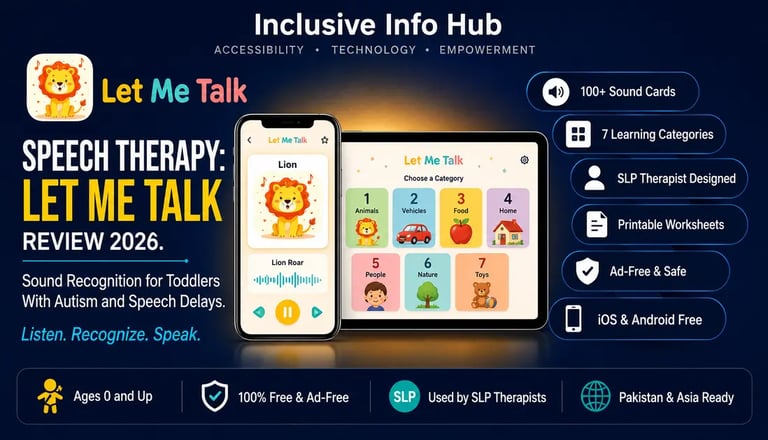
More Than 100 Sound Cards Across 7 Categories — the core content library, covering wild animals, home animals, musical instruments, outdoor sounds, household sounds, human sounds, and toy sounds. Each card pairs a high-quality recorded sound with an illustrated image of its source.
Seven Categories in Full:
Wild Animals — lion, bear, monkey, camel, wolf and more
Home Animals — horse, cow, goat, pig, dog and more
Musical Instruments — guitar, maracas, violin, piano, drum and more
Outside — motorbike, rocket, helicopter, storm, wind and more
In a Flat — washing machine, hair dryer, shower, doorbell and more
Human Sounds — kiss, laugh, cry, singing, clapping and more
Toys — ball, robot, rattle, rubber duck and more
Printable Colorful Worksheets — a feature that genuinely stands out as unusual for a free mobile app. Parents and SLP therapists can print physical activity sheets directly from the app, extending the learning experience offline and making the content usable in non-screen contexts — which matters both for screen time management and for clinical settings where paper materials are preferred.
Personalized Settings — the app includes settings that allow parents to customize the play experience for their child's specific pace and preferences, reflecting the clinical understanding that one-size-fits-all approaches are rarely optimal for children with developmental differences.
Different Game Modes — multiple interaction formats within the app prevent the repetition fatigue that a single fixed format inevitably produces for young children over time.
SLP Therapist Collaboration — the developer actively works with speech-language pathologists to develop sounds, motor cards, and games, with a stated commitment to ongoing collaboration for new content updates. Coming features include an articulation station, motor skills station, and order sounds station — expansions that would extend the app's coverage further into clinical therapy territory.
100 Percent Safe and Ad-Free — the app explicitly commits to a completely ad-free environment, which is not a given in the free educational app market and which matters significantly for parents of young children who do not want commercial interruptions during therapeutic activities.
Available on Both iOS and Android — confirmed available on both the Apple App Store and Google Play Store, making it accessible to families regardless of device type across Pakistan, India, and globally.
The Play Model: How a Session Actually Works
The recommended play flow is simple enough to follow without a manual:
A parent or caregiver chooses any category card from the menu, selects a specific card within that category, and lets the child listen to the associated sound. The parent then asks whether the child knows what made that sound, explains it, and shows the illustrated image alongside the sound. They can swipe or use arrows to move to the next card, and can layer in discussion and questions at whatever depth the child is ready for.
This is recognizable as a structured play-based intervention approach — the kind that occupational therapists and speech-language pathologists use in clinical settings, adapted into a format that an untrained parent can implement meaningfully at home without specialized knowledge.
A parent in Lahore at 7pm after work does not need a clinical background to play this app with their child effectively. They need five minutes, a phone, and the willingness to sit on the floor.
Honest Limitations
The app's text-to-speech voices and sound quality have been noted by some users as basic relative to more polished commercial apps. This is a reasonable observation and worth acknowledging honestly — the audio quality of the sound cards is good but not at the premium production level of paid educational apps from larger studios.
The most recent major update on Google Play is listed as April 3, 2026, suggesting the app is actively maintained, but the version history shows relatively infrequent major updates compared to larger commercial competitors. For a free, SLP-collaborated tool this is understandable — PapaDevApps is a small developer, not a major studio — but families should factor in that the feature roadmap depends on a small team's capacity and donation-style funding model.
The app currently does not include Urdu, Hindi, or Arabic language support for the interface or audio descriptions, which limits its reach for families in Pakistan and South Asia who would benefit from native-language content delivery alongside the sound cards. The sounds themselves are universal — a lion's roar is a lion's roar in any language — but the surrounding instructions and game modes are in English only.
The app does not yet offer the articulation station, motor skills station, or order sounds features mentioned in the developer's roadmap description, though these are stated as coming soon. Families should download the current version for its existing sound-card and worksheet features rather than on the basis of forthcoming features.
Play Store Details — Verified
Google Play Store: Search "Speech Therapy: Let me Talk" — developed by PapaDevApps, package identifier. Free to download. Rated 4.1 stars from 170 reviews. Last updated April 3, 2026. click here to download https://play.google.com/store/apps/details?id=com.unicef.cboard&pcampaignid=web_share
Frequently Asked Questions
Is Speech Therapy: Let Me Talk a replacement for a real speech-language pathologist? No, and the app itself does not claim to be. It is a home practice tool designed to supplement professional SLP therapy, not replace it. Families dealing with significant speech delays or autism-related communication differences should pursue formal SLP assessment and intervention alongside any app-based practice.
What age is this app designed for? The app is designed from birth onwards, with the content most actively useful during the toddler and preschool years when auditory discrimination and early language skills are developing most rapidly. Older children with developmental delays may also benefit depending on their individual communication profile.
Is Speech Therapy: Let Me Talk free with no hidden costs? Yes. The app is completely free to download and use on both Android and iOS with no in-app purchases, no subscription tiers, and no advertising within the app experience.
Is this app available in Pakistan? Yes. The app is available globally on both Google Play and the Apple App Store with no regional restrictions and no cost, making it fully accessible to families in Pakistan, India, Bangladesh, and across South Asia.
How is this different from AAC apps like SabiKo or Proloquo2Go? AAC apps give a nonverbal person a communication voice they can use right now — they are tools for expressing immediate needs and thoughts. Speech Therapy: Let Me Talk is a pre-speech listening skills tool that builds the auditory foundations that speech development depends on. Both types of apps can be relevant for a child with autism, but they serve different purposes and should not be confused with each other.
What This Means for Families in Pakistan and Across Asia
Whether you are a parent in Lahore with a toddler who is not yet meeting speech milestones, a special education teacher in Karachi looking for structured sound activities to use between therapy sessions, or an SLP therapist in Dhaka recommending home practice tools to families who cannot afford frequent clinical visits — Speech Therapy: Let Me Talk offers something genuinely practical: a free, ad-free, SLP-collaborated listening activity that any parent can use on the Android or iOS device they already own, at any time, in any place, with no internet connection required after initial download.
The interface language limitation — English only, with no Urdu or regional language options — is a real gap for families where English is not the household medium. The sounds themselves transcend language barriers completely, and a parent can conduct the listening activities entirely in Urdu or any other language while using the app's images and sounds as prompts. But the gap is still worth naming, and it represents an opportunity for the developer to meaningfully extend the app's impact across South Asia with relatively modest localization investment.
For families navigating an educational system that frequently underresources early speech intervention, and a private therapy market that can price consistent SLP access out of reach for ordinary households, this app represents something simple and important: one more tool in a parent's hands on the six days between appointments.
A Closing Thought
There is a specific kind of helplessness that settles over a parent who knows their child needs more practice, more exposure, more repetition — and who does not know how to provide it without a degree in speech-language pathology. Every parent wants to help. Most parents are not trained therapists. The gap between those two facts is where a child's early communication development so often gets lost.
Speech Therapy: Let Me Talk does not close that gap entirely. No app does. What it provides is a structured, evidence-informed, SLP-collaborated starting point that any parent can follow — not because it replaces professional guidance, but because it makes the space between professional sessions useful rather than empty.
For a toddler in Lahore or Karachi or anywhere else in the world whose brain is in its most receptive window for language learning, a parent sitting on the floor with a phone, a sound card, and twenty minutes of unhurried attention is not a substitute for therapy. It is the complement that makes therapy work.
Read More on Inclusive Info Hub
👉 Proloquo2Go — the most established AAC app and its Android alternatives: Read our full review here → [https://inclusiveinfohub.com/proloquo2go-review-the-aac-app-giving-nonverbal-users-their-voice-and-what-to-use-if-you-dont-have-an-ipad]
👉 Spoken — Tap to Talk AAC — AI-powered communication for adults with aphasia and speech loss: Read our full review here → [https://inclusiveinfohub.com/spoken-tap-to-talk-aac-review-2026-the-android-first-voice-for-adults-who-cant-speak]
👉 Best AI Accessibility Tools in 2026 — the complete guide across all disability categories: Read our full guide here → [https://inclusiveinfohub.com/best-ai-accessibility-tools-in-2026-how-artificial-intelligence-is-finally-closing-the-access-gap]